
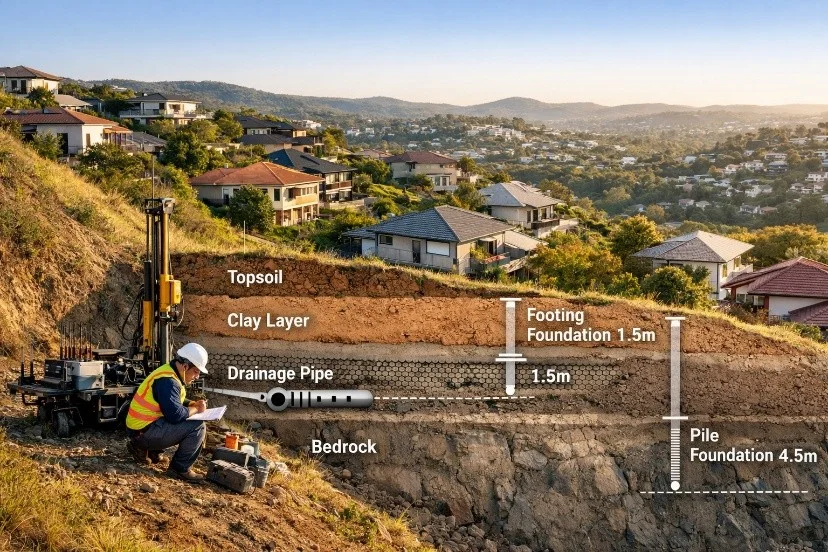
If you’re planning to build, excavate, or install a retaining wall on a sloped property in Brisbane, there’s a good chance Brisbane City Council will ask for a Slope Stability Report Brisbane before they approve your development application (DA).
This isn’t just paperwork for the sake of it. Brisbane’s hilly suburbs — from The Gap and Ferny Grove to Kenmore and Pullenvale — sit on terrain that can shift, erode, or slide if not properly assessed. A professional site stability assessment Brisbane protects you, your neighbours, and your investment.
This guide breaks down exactly what’s required, why it matters, and how to get it done right the first time.
What Is a Slope Stability Report?
A slope stability report is a formal technical document prepared by a qualified Geotechnical Engineer Brisbane. It assesses whether the ground on or around your property can safely support the proposed construction or earthworks.
The report looks at things like:
- Soil and rock type
- Slope angle and height
- Groundwater presence
- Erosion risk
- Existing structures nearby (like retaining walls or buildings)
The goal is simple — to confirm that your land won’t move in a way that causes damage or danger.
When Does Brisbane Council Require One?
Not every job needs a Slope Stability Report Brisbane, but council typically requires one in these situations:
- Building on a slope steeper than 15% — This is a common threshold. If your block has a notable grade, expect a geotechnical report to be part of your DA checklist.
- Installing or replacing a retaining wall over 1 metre — A retaining wall assessment Brisbane is often needed to confirm the wall design suits your soil conditions.
- Earthworks or cut-and-fill operations — Any significant ground shaping can disturb existing stability.
- Properties in landslide-prone overlays — Brisbane’s planning scheme includes overlays that flag known risk areas. If your land is mapped under the Steep Land or Landslide Overlays, a geotechnical report is almost always mandatory.
- New dwellings or extensions near steep embankments — Especially where the structure sits within the potential failure zone.
If you’re unsure whether your project needs one, check your property’s overlays on Brisbane City Council’s PD Online mapping tool, or speak directly with a Geotechnical Engineer Brisbane early in your planning process.
What Must the Report Include?
Brisbane Council doesn’t just want any report — it needs to meet specific technical standards. A compliant site stability assessment Brisbane generally includes:
1.Site Description and Investigation
The engineer will visit the site, log soil samples (usually through test bores or trial pits), and document the slope’s physical characteristics. This forms the backbone of the whole report.
2. Geotechnical Analysis
Using the site data, the engineer calculates what’s called the Factor of Safety (FoS) — a number that tells you how stable the slope is. A FoS of 1.5 or higher under normal conditions (and 1.2 under extreme rainfall) is typically what Council looks for.
3. Landslide Risk Assessment Queensland
For properties in mapped overlay areas, the report must specifically address Landslide Risk Assessment Queensland requirements. This includes identifying potential failure mechanisms — shallow slides, deep-seated movement, rockfall — and how the design mitigates them.
4. Retaining Wall Design Review
If a retaining wall assessment Brisbane is part of your scope, the report should confirm that the wall type, depth, and materials suit the soil bearing capacity and groundwater conditions. This often ties directly into the structural engineer’s design.
5. Recommendations and Construction Controls
Good reports don’t just flag risks — they tell you how to manage them. You’ll get practical recommendations like drainage requirements, vegetation retention, fill compaction specs, or specific footing depths.
6. Engineer Credentials and Sign-Off
Brisbane Council requires the report to be signed by a Registered Professional Engineer of Queensland (RPEQ). Always confirm your engineer holds this registration before commissioning the work.
How the Process Works
Here’s a simple step-by-step overview of how a typical slope stability report Brisbane project unfolds:
1. Initial consultation — You brief the Geotechnical Engineer Brisbane on your project scope and timeline.
2. Site investigation — The engineer visits, logs, and samples the soil. This may take a day or two depending on the site.
3. Lab testing — Soil samples are sent for testing to determine strength and moisture characteristics.
4. Report preparation — The analysis is compiled into a formal report, usually within 2–4 weeks.
5. DA submission — The report is lodged with your Development Application. Council may request additional information or clarification.
6. Construction monitoring — Some reports require the engineer to inspect key stages during construction to confirm compliance.
Common Mistakes That Delay Council Approval
Avoiding these errors can save you weeks of back-and-forth:
- Using a non-RPEQ engineer — Council won’t accept reports from unregistered practitioners.
- Skipping the site investigation — Desktop-only assessments are rarely accepted for high-risk sites.
- Missing the overlay requirements — If your land sits under a Landslide Risk Assessment Queensland overlay, a generic stability report won’t be enough.
- No drainage recommendations — Poor drainage is one of the top causes of slope failure in Brisbane. If the report doesn’t address it, expect council to push back.
- Outdated references — Ensure your engineer uses current Australian Standards and Brisbane’s planning scheme provisions.
How Much Does It Cost?
Costs vary based on site complexity, slope height, and investigation requirements. As a rough guide:
- Simple Site Stability Assessment Brisbane for a retaining wall: $1,500–$3,500
- Full slope stability report for a DA with bores and lab testing: $3,500–$8,000+
- Complex sites in landslide overlay areas: $8,000+
Always get a detailed scope of work before agreeing to a fee, and don’t cut corners on the site investigation stage — it’s the foundation of everything else.
A Slope Stability Report Brisbane isn’t just a Council formality — it’s a document that protects your property, your build, and the people around you. Getting it right from the start means faster approvals, fewer surprises on-site, and a structure that performs safely for decades.
Work with a qualified Geotechnical Engineer Brisbane, make sure your report is RPEQ-certified, and flag your overlay status early. That combination gives you the best shot at a smooth, stress-free approval process.
It’s a geotechnical document that proves your sloped land is safe to build on — Brisbane Council requires it for many development approvals.
Generally, when your retaining wall exceeds 1 metre in height or sits on unstable or steep ground.
Only a Registered Professional Engineer of Queensland (RPEQ) with geotechnical expertise — unregistered reports won’t be accepted.
It identifies landslide hazard types on your property and recommends design measures to reduce that risk under Queensland’s planning requirements.
Typically, 3–5 weeks from site investigation to final signed report, depending on lab turnaround and site complexity.
