
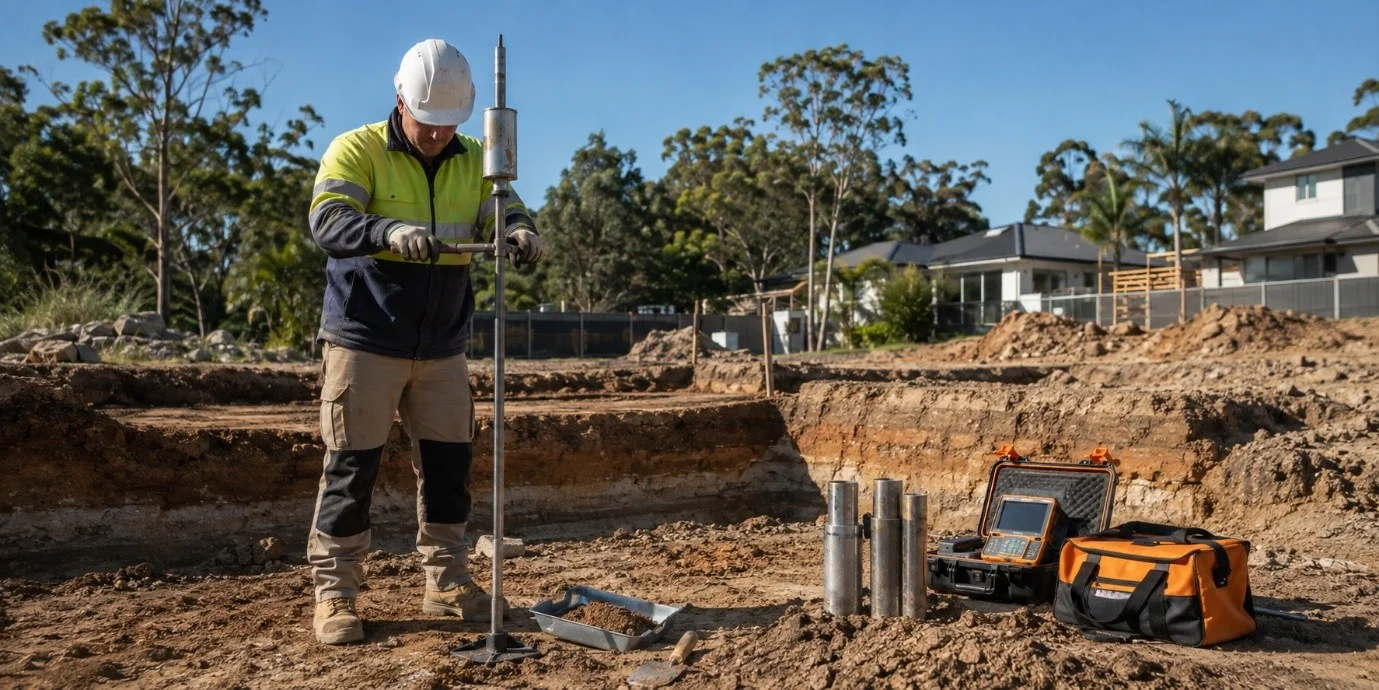
Building a new home, extension, commercial property, or other structure is a major investment. Before the first footing is poured or the first wall is raised, there is one part of the site that deserves serious attention: the ground beneath it. Soil Testing Brisbane gives builders, engineers, architects, and property owners useful information about the soil conditions that can influence foundation design, construction methods, project costs, and long-term building performance.
Brisbane properties can have very different ground conditions, even within the same general area. Soil may contain reactive clay, sand, rock, fill, or layers with different engineering characteristics. Australian building guidance uses site classifications to describe how foundation soils may respond to moisture-related movement, ranging from relatively stable Class A sites through reactive classes and problem sites.
Why Is Soil Testing Brisbane So Important Before Construction?
A building transfers its weight into the ground through its foundation. If the ground has insufficient strength, changes volume with moisture, contains uncontrolled fill, or has other unexpected conditions, the foundation design may need to change.
Professional Soil Testing Brisbane helps establish what is actually beneath the proposed building area rather than relying on assumptions. A typical investigation may involve site assessment, boreholes or test locations, Dynamic Cone Penetrometer (DCP) testing, soil sampling, laboratory analysis where required, and preparation of an engineering report. The exact scope depends on the property, proposed construction, site conditions, and project requirements.
Brisbane Soil Conditions Can Vary Significantly
One of the biggest reasons Geotechnical Testing Brisbane matters is that soil conditions are not uniform across the city. A property may appear perfectly stable from the surface while the layers underneath behave differently. Reactive clay, for example, can expand when it gains moisture and shrinks as it dries. If movement occurs unevenly beneath a structure, it can place stress on slabs, footings, walls, finishes, and other building components.
Brisbane’s varied ground conditions mean that assumptions based on a neighbouring property are not a substitute for testing the actual construction site. Recent engineering guidance also highlights that reactive clay conditions can vary by location and that site classification is specific to the individual block.
This is particularly important for sloping blocks, sites with previous development, properties containing fill, extensions to existing structures, and projects where ground conditions appear inconsistent.
Understanding Site Classification
One of the important outcomes of residential soil investigation is site classification.
Under the Australian framework for residential slabs and footings, classifications describe the expected behaviour of foundation soils. Broadly, Class A represents most stable sand and rock sites, while S, M, H1, H2 and E represent progressively more reactive soil conditions. Class P is used for certain problem sites, including conditions such as soft soils, uncontrolled fill, landslip, erosion or other circumstances requiring special consideration.
| Site Class | General Ground Behaviour | Construction Consideration |
| A | Generally stable sand or rock | Usually little moisture-related movement |
| S | Slightly reactive soil | Limited ground movement |
| M | Moderately reactive clay or silt | Foundation design needs to account for movement |
| H1 | Highly reactive soil | Greater moisture-related movement requires additional consideration |
| H2 | Very highly reactive soil | Significant movement potential |
| E | Extremely reactive soil | Very high movement potential and specialist design consideration |
| P | Problem site | Site-specific engineering solutions may be required |
The table is a simplified guide rather than a replacement for an engineering assessment. Actual classification must be established from appropriate site investigation and assessment.
How Soil Movement Can Affect a Building
Reactive soil does not automatically mean that construction cannot take place. The important point is understanding how the soil behaves so the building can be designed appropriately.
Clay soils can change volume as their moisture content changes. When the soil becomes wetter, it may swell. During drying conditions, it can shrink. If the moisture change is uneven across a building footprint, different parts of the foundation may experience different levels of movement.
Over time, uncontrolled or poorly managed movement may contribute to issues such as:
- Slab movement
- Cracking in walls or finishes
- Uneven floors
- Doors and windows becoming difficult to operate
- Movement around extensions
- Drainage-related ground problems
The Australian NCC links foundation classification to AS 2870 and recognises different soil classes according to their potential for moisture-related movement. This is one reason Soil Report Brisbane should happen before foundation decisions are finalised.
Soil Testing Can Influence Foundation Design
A foundation should suit the conditions beneath it. Without reliable information about the soil, a design team may have incomplete information when determining an appropriate foundation system.
The soil report can provide information that assists engineers and builders with decisions involving:
- Footing configuration
- Slab design
- Foundation depth
- Ground improvement
- Pier or pile considerations where appropriate
- Site preparation
- Drainage considerations
- Management of unsuitable or uncontrolled fill
The specific foundation solution should always be determined by the appropriately qualified design professional based on the site investigation, structural requirements, applicable standards, and project conditions. This makes Soil Testing Brisbane much more than a report that gets filed away. The findings can become an important input into the design process.
Can Soil Testing Help Control Construction Costs?
It may seem that testing adds another expense to a construction project. In reality, obtaining information early can help reduce uncertainty.
Imagine discovering unexpected weak soil after excavation has already started. The project may then require additional excavation, imported material, ground improvement, redesign, or other engineering work. These changes can affect the schedule as well as the budget.
A pre-construction investigation provides an opportunity to identify potential ground-related issues earlier.
Geotest Group notes that investigation scope and costs can vary depending on the complexity of the site and that unforeseen conditions may sometimes require additional excavation, laboratory testing, or review.
What Does a Soil Testing Process Usually Involve?
The exact process varies between projects, but a typical Soil Testing Brisbane investigation may include several stages.
1. Initial Site Assessment
The testing professional reviews the property and proposed construction requirements. Site access, topography, visible ground conditions, vegetation, existing structures, fill, drainage and other relevant factors may be considered.
2. Field Testing
Testing locations are selected based on the site and proposed development. Methods may include boreholes, test holes, DCP testing and other investigation techniques appropriate to the project.
Geotest Group describes shallow investigations that can involve auger holes, shear vane testing and DCP testing, while deeper investigations may use methods such as cone penetration testing or machine boreholes where appropriate.
3. Soil Sampling and Analysis
Samples may be collected for further assessment or laboratory testing where required. Depending on the investigation, testing can help establish properties such as soil classification, reactivity and other engineering characteristics.
4. Engineering Assessment
The collected information is assessed by the relevant technical professional. This is where raw field and laboratory results are turned into useful engineering information.
5. Soil Report
The final report documents the findings and can provide site classification and recommendations relevant to the proposed construction.
Why Builders Should Not Rely on Guesswork
A common mistake is assuming that a nearby property will have exactly the same ground conditions.
Two blocks in the same suburb can have different soil profiles because of changes in natural geology, previous earthworks, filling, drainage, slope, vegetation and other site-specific factors.
A previous soil report can also have limitations if site conditions or the proposed development have changed. For that reason, the appropriate investigation should be considered for the actual project rather than simply copying information from another property.
Professional Pre-Construction Soil Testing Brisbane provides project-specific information that allows the construction team to work from evidence rather than assumptions.
When Should Soil Testing Be Done?
The best time is before construction design and foundation decisions are locked in.
For a new home, testing can be arranged after the property and proposed building area are known. For extensions, retaining walls, commercial developments, sheds, pools, and other projects, the investigation requirements may differ.
Testing too late can create unnecessary complications. If the foundation design has already been completed and unexpected soil conditions are discovered during construction, changes may become more disruptive.
What Can Happen If Soil Testing Is Skipped?
Skipping testing does not guarantee that a building will develop problems. However, it removes important information that could have helped identify site conditions before construction. The goal of testing is not to make every site appear perfect. The goal is to understand the site well enough for the project team to make informed decisions.
Choosing a Soil Testing Provider in Brisbane
When selecting a provider, consider more than price alone.
Look for a company with relevant geotechnical experience, appropriate testing capabilities, qualified professionals, clear reporting, and experience with the type of project you are planning.
It is also useful to ask:
- What testing methods will be used?
- Will the investigation provide the site classification required for my project?
- Who will assess and prepare the report?
- Are additional tests likely based on the site conditions?
- What information will the final report provide?
- Does the provider have experience with similar Brisbane projects?
Geotest Group provides geotechnical investigation and soil testing services across Brisbane and surrounding South East Queensland areas, including site classification and slope stability-related investigations.
Is Soil Testing Really the Most Important Step?
Construction has many important stages: planning, design, approvals, engineering, materials, workmanship and inspections. Soil testing cannot replace those steps. However, it can be argued that Soil Testing Brisbane is one of the most important early investigations because the ground supports everything built above it.
A beautifully designed building can still face problems if its foundation is not appropriate for the ground conditions. Conversely, when the soil is properly investigated and the findings are incorporated into the design, the project begins with a much stronger understanding of its physical environment.
Before concrete is poured, walls are framed, or construction equipment arrives on site, take the time to understand what lies beneath the proposed building. Soil Testing Brisbane can identify soil characteristics, reactive conditions, potential ground movement and other factors that may influence foundation and construction decisions.
Soil testing identifies important ground characteristics such as soil type, reactivity, strength and potential moisture-related movement. The findings can help engineers and builders develop foundation and construction approaches suited to the site.
Depending on the project, an investigation may assess soil profile, strength, reactivity, site classification, fill conditions and other geotechnical factors. Field testing and laboratory analysis may be included where appropriate.
Yes. Soil behaviour and site classification can influence foundation and slab design. Reactive soils, weak layers, fill and other ground conditions may require specific engineering consideration.
Soil testing should generally be arranged early, before foundation design and construction decisions are finalised. Early investigation gives the project team an opportunity to respond to ground
The timeframe depends on the project scope, site access, investigation methods and whether laboratory testing is required. Geotest Group states that many standard results can be delivered within several business days, while complex investigations may require additional time.


