
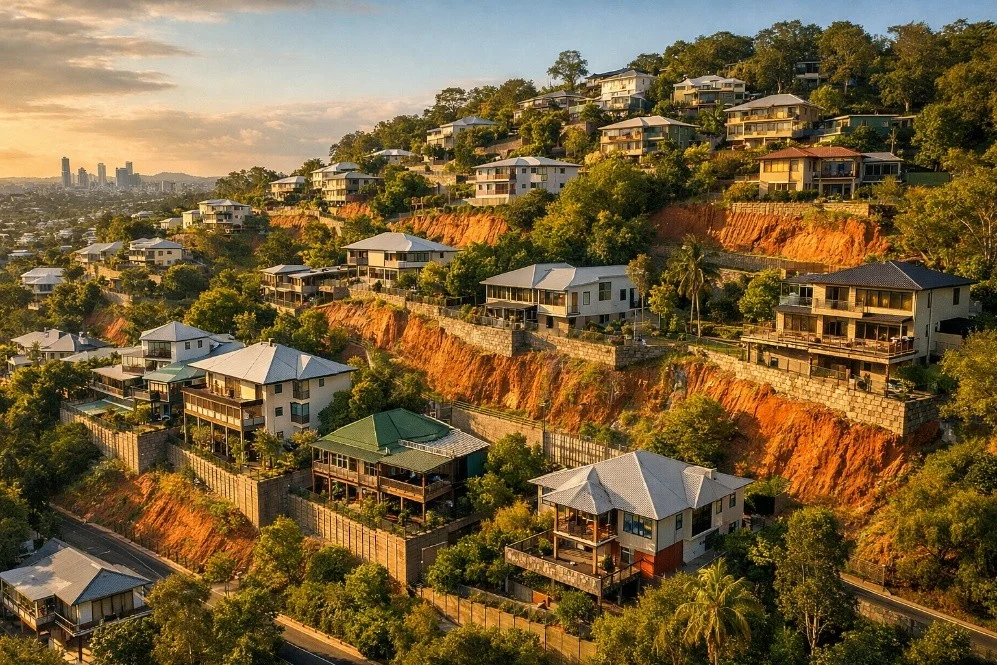
Yes — you can build in a slope stability hazard overlay area in Brisbane. However, Brisbane City Council requires a Slope Stability Report Brisbane, a Site stability assessment Brisbane, and in most cases, sign-off from a Geotechnical engineer Brisbane before your Development Application (DA) is approved.
What Is a Slope Stability Hazard Overlay Area in Brisbane?
A slope stability hazard overlay area is a zone identified in the Brisbane City Plan 2014 where land may be at risk of movement, landslide, or ground failure — particularly on steep or unstable terrain.
It does not mean your land is unsafe to build on. It means Brisbane City Council requires additional technical evidence before granting approval.
A slope stability overlay flags land with potential ground movement risk. It triggers extra assessment requirements — not an automatic building ban.
Which Brisbane Suburbs Are Commonly Affected?
Many hilly and inner-city suburbs in Brisbane fall under this overlay, including:
- Bardon
- Paddington
- Kenmore
- Ferny Hills
- St Lucia
- Tarragindi
- Toowong
You can check your specific property using Brisbane City Council’s online mapping tool (PD Online) to confirm your overlay status and hazard level.
What Reports Do You Need to Build in a Slope Stability Overlay?
If your property is in a slope stability hazard overlay area, Council typically requires four key documents:
Slope Stability Report Brisbane
A Slope stability report Brisbane models how stable your slope is under load, rainfall, and construction conditions. It is the most commonly required document for DA lodgement in overlay areas.
How Does the Approval Process Work? (Step-by-Step)
Here’s exactly what the process looks like when building in a slope stability hazard overlay area in Brisbane:
1. Confirm your overlay — Use PD Online to check your property’s hazard level (High or Medium).
2. Engage a Geotechnical engineer Brisbane — They visit your site, take soil samples, and begin their assessment.
3. Get your reports prepared — Including your Slope stability report Brisbane, Site stability assessment Brisbane, and Retaining wall assessment Brisbane.
4. Check if Landslide risk assessment Queensland guidelines apply — For high-risk sites, Queensland State Government standards may also need to be met alongside Council requirements.
5. Lodge your Development Application — Submit to Brisbane City Council with all required reports and engineering drawings attached.
6. Respond to conditions — Council may issue conditions of approval. Your engineer helps you address them.
7. Build with approval — Construction proceeds in line with your engineer’s recommendations.
What Happens if You Skip the Required Assessments?
Skipping reports is a costly mistake. Here’s what’s at risk:
- DA rejection — Council will not approve your application without required reports
- Stop-work orders — Council can halt construction on-site
- Structural failure — Without proper Geotechnical Engineer Brisbane sign-off, your build may be on unsafe ground
- Insurance voids — Claims may be denied if assessments weren’t completed
- Neighbour liability — If your build destabilises adjoining land, you may face legal action
Does a Slope Stability Overlay Affect Property Value?
Not necessarily. Properties inside slope stability overlay areas are bought, sold, and developed regularly across Brisbane. When the right assessments confirm a site is buildable, the overlay rarely affects market value significantly.
What matters most is having a clean Site stability assessment Brisbane and any required Slope stability report Brisbane on file — this gives future buyers confidence too.
Who Do You Need to Hire?
| Role | What They Do |
| Geotechnical Engineer Brisbane | Soil and rock assessment, foundation recommendations |
| Civil/Structural Engineer | Retaining wall design, drainage, earthworks |
| Town Planner | DA preparation and Council liaison |
| Building Designer/Architect | Design that responds to slope and site conditions |
Hiring professionals with Brisbane-specific overlay experience is critical. They know how to frame reports in a way that satisfies Council’s specific requirements.
Key Tips Before You Build
- Start early — Reports take 1–3 weeks. Don’t leave it to the last minute.
- Check your hazard level — High and Medium hazard areas have different requirements.
- Plan your drainage — Poor drainage is the #1 cause of slope failure. Design it properly from day one.
- Don’t assume the worst — Many overlay properties get DA approval without major issues.
- Review Landslide risk assessment Queensland standards for high-risk sites before engaging engineers.
Yes, You Can Build — With the Right Support
Being in a Slope Stability Hazard Overlay Area In Brisbane is not a deal-breaker. It’s a process.
With a solid Slope stability report Brisbane, a thorough Site stability assessment Brisbane, and the guidance of an experienced Geotechnical engineer Brisbane, most projects in overlay areas are approved and built successfully.
Get the right reports. Hire the right team. Start the process early. That’s the formula that works.
Yes — you can build, but you’ll need a Slope stability report Brisbane and Site stability assessment Brisbane as part of your DA.
A Geotechnical engineer Brisbane tests your soil and ground conditions and recommends safe foundation and drainage solutions for your site.
Only if your project involves cut and fill or walls over 1 metre — a Retaining wall assessment Brisbane is mandatory in most of those cases.
A Landslide risk assessment Queensland evaluates the likelihood of a landslide on or near your site, often required for high hazard overlay properties.
A Site stability assessment Brisbane typically takes 1–3 weeks depending on site complexity and the engineer’s workload.


