
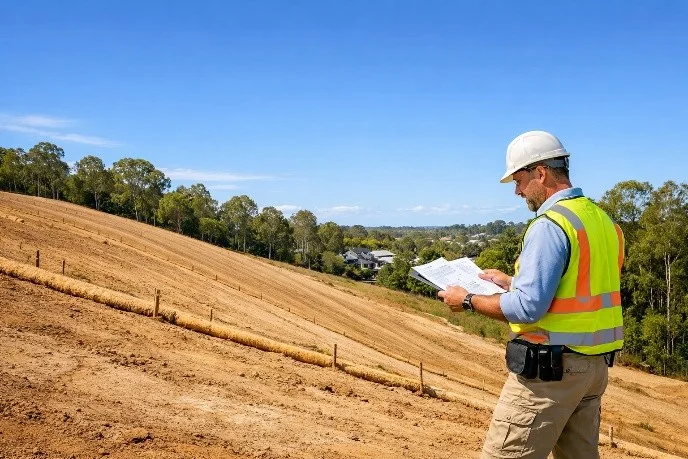
A Slope Stability Assessment Brisbane is a geotechnical evaluation that determines whether sloped land is structurally safe for construction. Conducted by a licensed Geotechnical Engineer Brisbane, this assessment analyses soil strength, slope gradient, moisture levels, and failure risk — producing a certified Slope Stability Report Brisbane used by councils, builders, and structural engineers to approve and guide construction.
If you are building, renovating, or subdividing on any sloped block in Brisbane or Southeast Queensland, this assessment is not optional — it is a fundamental safety requirement.
Why Is Slope Stability Assessment Critical in Brisbane?
Brisbane’s landscape is characterised by hilly terrain, clay-rich reactive soils, and high seasonal rainfall — a combination that directly increases landslide and slope failure risk. Suburbs like Kenmore, Pullenvale, Fig Tree Pocket, Ferny Grove, and Mount Gravatt all sit on terrain that demands proper geotechnical review before any structure is built.
According to Geotest Group, a leading Geotechnical Engineer Brisbane with over 10 years of experience across Southeast Queensland, slope failures most commonly occur because:
- Soil saturation from heavy rainfall weakens the ground’s shear strength
- Poor drainage behind retaining walls builds up hydrostatic pressure
- Construction loads are placed on slopes without adequate geotechnical analysis
- Reactive clay soils expand and contract, destabilising foundations over time
Without a Site Stability Assessment Brisbane, these risks go undetected — and the consequences can be costly, dangerous, and legally complex.
What Does a Slope Stability Assessment Include?
A certified Slope Stability Report Brisbane from Geotest Group covers the following:
Site Inspection: A qualified engineer inspects the slope for visible signs of movement, erosion, cracking, or geohazards. This is the starting point for every assessment.
Soil Testing: On-site tests including hand augers, Dynamic Cone Penetrometer (DCP) tests, and shear vane tests are performed to depths of 3–4 metres. These tests measure soil strength, composition, and moisture behaviour under load.
Laboratory Analysis: Soil samples are tested in a certified lab to assess bearing capacity, expansivity, and classification according to Australian Standard AS2870-2011.
Slope Stability Modelling: Using advanced Finite Element software, engineers model worst-case scenarios — heavy rainfall, added structural load, and soil saturation — to calculate how stable your slope is under real conditions.
Final Geotechnical Report: The completed Slope Stability Report Brisbane includes subsoil profiling, risk ratings, foundation recommendations, and remediation options if instability is found.
When Do You Need a Slope Stability Assessment in Brisbane?
You need a Slope Stability Assessment Brisbane in these specific situations:
- Building on sloped land — Any block with a gradient above 15% typically triggers a council requirement for geotechnical review
- Installing a retaining wall — A retaining wall assessment Brisbane is required to ensure the wall design can safely handle soil pressure, drainage, and load
- Subdividing sloped land — Urban and rural subdivision approvals across Brisbane require a geotechnical report as part of the development application
- After flooding or heavy rain — Saturated soils lose shear strength rapidly, making post-rainfall assessments essential
- Visible land movement — Cracking soil, leaning structures, or uneven ground are warning signs that need immediate assessment
Brisbane City Council and most Southeast Queensland local governments will not grant development approval on steep or landslide-prone sites without a certified geotechnical report. Missing this step can delay your entire project.
Understanding Landslide Risk in Queensland
Landslide risk assessment Queensland is relevant to both rural properties and Brisbane’s urban hillside suburbs. Queensland’s geology — layered clay, weathered rock, sandy fill, and expansive subsoils — makes many sites naturally susceptible to slope movement, particularly during the wet season.
A landslide risk assessment Queensland identifies:
- High-saturation zones where soil loses stability under rainfall
- Weak subsurface layers prone to sliding under structural load
- Inadequate drainage paths that increase hydrostatic pressure
- Safe construction setback zones and slope gradient limits
Geotest Group conducts these assessments across Brisbane, Sunshine Coast, Gold Coast, Ipswich, and Logan — providing site-specific risk ratings and practical engineering solutions for each location.
Retaining Wall Assessment: A Non-Negotiable Step
A Retaining Wall Assessment Brisbane is one of the most commonly skipped — and most consequential — geotechnical steps in residential construction. Retaining walls hold back tonnes of soil pressure. Without a proper geotechnical basis, even well-built walls can fail.
Geotest Group’s retaining wall assessment Brisbane ensures:
- Wall footing depth suits actual soil conditions
- Drainage design prevents water pressure build-up behind the wall
- Structural loads are matched to the soil’s real bearing capacity
- Design complies with Brisbane City Council and Queensland Building Code requirements
How Much Does a Slope Stability Report Cost in Brisbane?
A Slope Stability Report Brisbane from Geotest Group typically costs between $1,800 and $6,000. The final price depends on land size, slope severity, number of test locations, and whether additional lab testing or council-required peer review is needed.
This cost is minor compared to the expense of slope failure, structural repair, legal liability, or complete demolition and rebuild.
Why Choose Geotest Group for Slope Stability Assessment in Brisbane?
Geotest Group is a fully qualified, registered professional engineering firm providing slope stability assessment Brisbane, site stability assessment Brisbane, retaining wall assessment Brisbane, and Landslide Risk Assessment Queensland services across Southeast Queensland.
- 10+ years of geotechnical experience in Brisbane and surrounds
- Finite Element software for accurate slope modelling
- Fast turnaround, including urgent job support
- Reports accepted by Brisbane City Council and SEQ local authorities
It is a geotechnical evaluation that determines whether sloped land is safe and structurally suitable for construction.
It is required for any development on steep, landslide-prone, or geotechnically complex land under Brisbane City Council guidelines.
It involves testing soil conditions, drainage, and load capacity to ensure the retaining wall is safely designed for the actual site.
Costs range from $1,800 to $6,000 depending on land size, gradient, and testing complexity.
Yes, Geotest Group provides landslide risk assessments across Brisbane, Gold Coast, Sunshine Coast, Ipswich, and Logan.

