
Uncategorized

Soil Testing Gold Coast: Guide for Builders & Developers

When you’re standing on a fresh patch of land on the coast, it’s easy to get caught up in the vision of the final structure. But for builders and developers, the most important part of the project isn’t what goes up—it’s what stays down. The ground across South East Queensland is notoriously fickle. From the shifting sands of the beachside suburbs to the heavy, stubborn clays of the hinterland, Soil testing Gold Coast is the only way to turn guesswork into a solid engineering plan.

Skipping or rushing this stage is a recipe for disaster. We aren’t just talking about a few small cracks in the plaster; we’re talking about structural failures that can bankrupt a project. If you want your development to stand the test of time, you need to understand exactly what is happening beneath the surface.

Why South East Queensland Dirt is Different

The geography of our region is incredibly diverse. If you are moving between projects, you’ll notice that soil testing Brisbane often involves dealing with rocky outcrops or old, settled alluvial soils near the river. However, once you head south, things change. Soil testing Gold Coast frequently encounters “Class P” sites where soft marine mud or uncontrolled fill makes building a massive challenge.

The stakes are high because of our weather. We live in a land of extremes. One month we are dealing with a flash-flooding downpour, and the next, we are in a heatwave. This cycle of wetting and drying causes “reactive” soils to move. If your soil report doesn’t accurately predict this movement, your slab will eventually heave or sink, leading to tens of thousands of dollars in rectification costs.

Soil testing Gold Coast

The Developer’s Secret Weapon: The Soil Testing Quote

I’ve seen plenty of developers try to shave costs by looking for the cheapest possible soil testing quote. It feels like a small win at the start, but it usually bites them later. A cheap report is often a “lazy” report. If the technician doesn’t drill deep enough or take enough samples, the structural engineer has to cover their own back by over-engineering the footings.

Think about it this way: if a detailed soil testing quote costs a few hundred dollars more but proves the ground is stable, your engineer can design a standard slab. If a cheap, vague report leaves the engineer uncertain, they might specify extra piers and thicker concrete just to be safe. On a multi-unit development, that “safe” guess could cost you $50,000 in extra materials that you didn’t actually need. Precision is where the profit is.

Regional Nuances: Logan and Beyond

Expanding your portfolio often means looking at different councils. If you are looking at Soil testing in Logan, you are entering a zone famous for “Black Soil” and heavy reactive clays. Logan has some of the most challenging building conditions in the state. The soil there can expand like a sponge when it rains.

When performing soil testing in Logan, technicians look closely at the Atterberg limits—basically how much water the soil can hold before it turns from a solid to a liquid state. Builders who take Gold Coast “sand” logic and try to apply it to Logan will find themselves in a world of trouble. Each region requires a local understanding of the geological history of the lot.

What Actually Happens During a Soil Test?

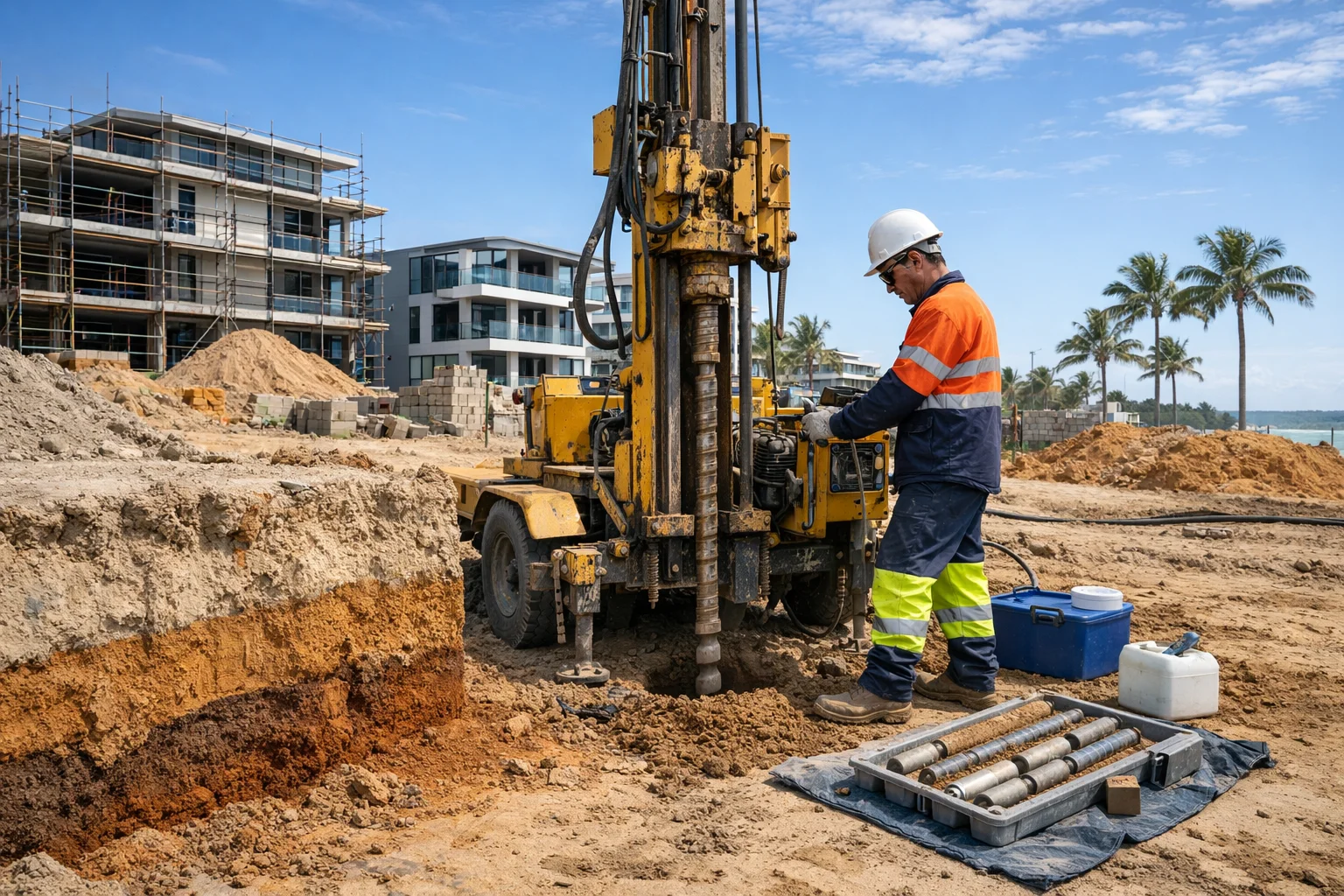
For the uninitiated, the process might look like a guy with a drill, but there is a lot of science involved. When you book soil testing Gold Coast, a specialized rig comes to the site to perform several boreholes.

  • Sample Extraction: They pull up soil from different depths to see the layers. One meter might be topsoil, but the next could be shifting sand or hard rock.
  • Tactile Assessment: The technician feels the texture to identify clay content on the spot.
  • Laboratory Testing: Samples are sent off to measure the “Linear Shrinkage” and “Plasticity Index.”
  • Site Classification: Finally, the site is given a grade (A, S, M, H, E, or P). This grade tells the builder exactly what kind of footing system is required by law.

Whether it is soil testing Brisbane for an inner-city renovation or soil testing in Logan for a new estate, this data is the “source of truth” for the entire build.

Soil testing Gold Coast

The Risk of Uncontrolled Fill

This is the silent killer for Gold Coast developers. Because so much of the coast has been developed and redeveloped, many lots have “fill”—dirt brought in from elsewhere to level the ground. If that fill wasn’t compacted and certified at the time, it is considered uncontrolled.

You cannot build a standard house on uncontrolled fill. It has no bearing capacity and will settle unevenly. Only a proper Soil testing quote that includes deep boring will catch this. I’ve seen developers buy “flat, ready-to-build” land only to find out they have to pier down six meters to find natural ground. That is a cost that can end a project before it starts.

How to Speed Up Your Project

Time is money in the construction world. To get your soil testing Gold Coast done quickly, make sure the site is accessible. If the rig can’t get past overgrown trees or piles of rubbish, you’ll get charged for a return visit.

Also, have your site plans ready. The technicians need to know exactly where the building footprint is. Testing the backyard when the house is going on the front of the lot is a waste of everyone’s time. This applies whether you are doing Soil testing Brisbane or anywhere else in SEQ.

Environmental Responsibility

Today’s developers also have to worry about acid sulphate soils, especially in low-lying coastal areas. When you get a soil testing quote, ask if they check for these. If you disturb acid sulphate soils without a management plan, you risk damaging the environment and facing massive fines from the council. It’s another layer of why “cheap” testing is never actually cheap.

At the end of the day, your reputation is built on the houses you leave behind. If a house starts cracking three years after handover, the owner won’t blame the dirt—they’ll blame you. By insisting on high-quality soil testing Gold Coast, you are protecting your brand.

Whether you are navigating the tight streets for soil testing Brisbane or the expanding suburbs for soil testing in Logan, remember that the dirt tells a story. Your job is to make sure you have someone qualified to read it. Don’t settle for the bare minimum. Get a comprehensive soil testing quote, understand your site classification, and build on a foundation of facts, not hopes.

1.How many boreholes are usually needed for a standard house lot?

For most residential lots, two to three boreholes are drilled to ensure a consistent reading across the building footprint.

2. Does a soil test cover the risk of landslides in hilly areas?

A standard soil test classifies the reactivity, but a “Slope Stability” report is usually needed for steep blocks on the Gold Coast.

3. Why do I need soil testing in Logan if the neighbor just built?

Soil conditions can change drastically within just a few meters, so one lot’s classification never guarantees the next one is the same.

4. What is the main difference with soil testing Brisbane inner-city lots?

Inner-city sites often have “hidden” issues like old footings, buried rubbish, or old utility pipes that require careful hand-angering.

5. Is the price of a soil testing quote fixed across South East Queensland?

Prices vary depending on site access, the number of holes, and whether additional tests like acid sulfate or compaction tests are needed.

Uncategorized

Top 5 Reasons Soil Testing Brisbane Matters for New Property Buyers

Purchasing a property in South East Queensland is a significant investment, often representing a lifelong dream. Whether you are eyeing a suburban block in a new estate or a knockdown-rebuild opportunity, the surface level aesthetics—the view, the neighborhood, and the proximity to amenities—are usually the first things people notice. However, for a savvy buyer, the most critical information lies several meters beneath the grass.

In the construction world, the ground isn’t just “dirt”; it is the structural partner of your home. From the dense clays found during Soil Testing in Logan to the sandy profiles common in Soil Testing Gold Coast, the geological makeup of your land dictates the longevity of your build.

Here is an in-depth look at the top five reasons why Soil Testing Brisbane is an absolute necessity for every new property buyer.

1. Navigating the Risks of Reactive Clay

The geology of the Brisbane River basin and its surrounding regions is notorious for “reactive” soils. Reactivity refers to how much the soil volume changes based on moisture content.

  • The Sponge Effect: Highly reactive clay acts like a sponge. In Brisbane’s humid, wet summers, the clay absorbs water and expands (heaves). In the dry winter months, it loses moisture and shrinks.
  • Structural Damage: If a house is built on a standard slab without accounting for this movement, the foundation will shift. This leads to the “classic” signs of structural failure: doors that won’t close, windows that jam, and large diagonal cracks in internal plaster or external brickwork.

Professional Soil Testing Brisbane provides a “Site Classification.” Knowing if your site is Class S (Slightly reactive), Class M (Moderately reactive), or Class H (Highly reactive) ensures your engineer designs a slab that can withstand these inevitable seasonal shifts.

2. Financial Predictability and Fixed-Price Contracts

One of the biggest stressors for new home buyers is “cost creep.” Many buyers sign a preliminary contract with a builder only to find themselves hit with $20,000 to $40,000 in “extra site costs” later.

Why does this happen? Most builders provide a base price assuming a flat, stable “Class A” site. If the Soil Testing Quote reveals that the ground is actually unstable or filled with rock, the builder must add:

  • Deep Piering: Drilling deep into the earth to find stable rock or soil to support the slab.
  • Extra Steel and Concrete: To strengthen the foundation against soil movement.

By getting Soil Testing Brisbane done during your due diligence period, you can take the report to builders and demand a fixed-price contract. This eliminates the “provisional sums” that often wreck a first-home buyer’s budget.

3. Identifying “Uncontrolled Fill” and Land Stability

In many developing suburbs, particularly when seeking Soil Testing in Logan, land is often “benched” or leveled using fill dirt. If this fill was not compacted correctly under the supervision of a certified engineer, it is considered “uncontrolled fill.”

Building on uncontrolled fill is a recipe for disaster. Over time, the weight of a house will cause the loose soil to settle unevenly. This can lead to a house literally tilting or sinking on one side. A geotechnical soil test involves drilling boreholes to check the density of the soil at various depths. If the test identifies uncontrolled fill, you will know immediately that the land requires specialized (and expensive) foundation work, which may influence your decision to purchase the block at all.

4. Tailoring Solutions for Coastal and River Conditions

The geography of South East Queensland varies wildly. If you are looking at Soil Testing Gold Coast, the challenges are often different from the inland suburbs. Coastal properties frequently deal with:

  • High Water Tables: This can affect how deep you can dig and may require specialized drainage systems.
  • Acid Sulfate Soils: When these soils are disturbed by construction, they can produce sulfuric acid, which eats away at concrete and metal pipes and harms the local environment.
  • Sand Stability: Sandy soils have great drainage but can be prone to erosion or “scouring” during heavy rain.

A localized soil test ensures that the unique environmental footprint of your specific suburb—be it the sand of the coast or the silt of the Brisbane River—is managed safely.

5. Legal Compliance and Resale Value

In Australia, building regulations (specifically AS 2870-2011) mandate that every new residential building must have a site classification report. You cannot receive a building permit from a private certifier or local council without one.

Beyond the legalities of construction, think about the long-term resale value. When you eventually sell your home, a “clean bill of health” regarding the foundation is a massive selling point. Conversely, if you skip proper testing and your home develops cracks, you will have to disclose these structural issues to future buyers, significantly lowering the property’s market value. Investing in a professional Soil Testing Quote today is an investment in your home’s future equity.

The excitement of choosing floor plans, kitchen tiles, and paint collars often overshadows the technical reality of the ground underneath. However, the soil is the only part of your home you cannot change once the house is built.

Whether you are navigating the clay-heavy regions of the west or seeking Soil Testing Gold Coast for a beachside villa, the data provided by a geotechnical engineer is the most valuable document in your property folder. It protects your bank account, your physical safety, and your peace of mind.

Before you commit to a purchase or a construction contract, ensure you have a comprehensive report for Soil Testing Brisbane. After all, a dream home is only as good as the ground it stands on.

FAQs – Soil Testing Brisbane for Property Buyers

1. Is soil testing mandatory before building in Brisbane?
Yes, soil testing is required to meet building and council approval standards.

2. When should new buyers arrange soil testing?
Ideally before finalising land purchase or submitting building plans.

3. Does soil testing increase construction costs?
It helps control costs by preventing unexpected foundation and design changes.

4. Can one soil report be used across regions like Logan or Gold Coast?
No, each site needs its own test due to varying soil conditions.

5. How do I get a Soil Testing Quote?
Contact a licensed geotechnical provider to assess site size and access.

Uncategorized

Soil Testing Gold Coast: A Complete Guide for Builders & Developers

Before laying the first brick on any construction project, understanding ground conditions is critical. Soil Testing Gold Coast plays a vital role in ensuring safe, compliant, and cost-effective construction for builders and developers. From residential homes to large commercial projects, soil testing helps identify risks early and supports smarter design decisions.

In this complete guide, we explain what soil testing involves, why it matters, and how builders can use accurate soil data to avoid costly delays and structural issues.

What Is Soil Testing and Why It Matters

Soil testing is a geotechnical investigation that examines soil composition, strength, moisture levels, and load-bearing capacity. On the Gold Coast, soil conditions can vary significantly due to coastal sands, clay layers, and reclaimed land.

For builders and developers, professional Soil Testing Gold Coast ensures:

  • Foundations are designed correctly
  • Structural failures are avoided
  • Projects comply with Australian Standards (AS 2870)
  • Unexpected construction costs are reduced

Skipping soil testing often leads to cracking, subsidence, drainage issues, and legal complications.

Types of Soil Tests Used on the Gold Coast

Builders rely on several soil testing methods depending on site conditions and project scale.

Common Soil Testing Methods

  • Borehole Drilling – Collects soil samples at various depths
  • Standard Penetration Test (SPT) – Measures soil strength
  • Test Pits – Exposes visible soil layers
  • Laboratory Analysis – Confirms soil classification and moisture content

These tests help engineers determine site classification (Class A, S, M, H, or P), which directly affects foundation design and construction cost.

Soil Testing Gold Coast

Why Builders & Developers Need Soil Testing

Accurate soil data is essential during the planning stage. Without it, design assumptions may fail once construction begins.

Key Benefits of Soil Testing

  • Prevents over-engineering or under-design
  • Reduces foundation repair costs
  • Improves long-term structural durability
  • Helps secure council approvals faster
  • Supports accurate budgeting and scheduling

Many developers working across Soil Testing Brisbane and Soil Testing in Logan follow the same standards, making soil reports essential across Queensland.

Understanding a Soil Report

A professional soil report provides clear recommendations for foundation design and site preparation.

What a Soil Report Includes

  • Soil classification and bearing capacity
  • Depth of reactive soil layers
  • Groundwater conditions
  • Drainage and erosion risks
  • Recommended footing systems

Builders use this information to coordinate with structural engineers, ensuring foundations match actual site conditions.

Soil Testing Costs and Quotes

The cost of soil testing depends on site size, access, and testing depth. However, it is a small investment compared to potential structural repairs.

What Affects a Soil Testing Quote

  • Number of boreholes required
  • Site accessibility
  • Project type (residential or commercial)
  • Local ground conditions

Requesting a detailed Soil Testing Quote upfront helps builders avoid hidden costs and ensures transparency.

Compliance and Australian Standards

All construction projects on the Gold Coast must comply with Australian building regulations. Soil testing supports compliance with:

  • AS 2870 – Residential slabs and footings
  • Local council development requirements
  • Engineering certification standards

Professional Soil Testing Gold Coast providers ensure reports meet regulatory expectations, reducing approval delays.

Soil Testing Gold Coast

When Should Soil Testing Be Done?

Soil testing should be conducted before:

  • Purchasing land
  • Finalising architectural designs
  • Applying for building approvals
  • Starting excavation work

Early testing allows developers to adjust designs before committing to construction, saving both time and money.

Choosing the Right Soil Testing Provider

Selecting an experienced provider ensures reliable results and actionable recommendations.

What to Look For

  • NATA-accredited laboratories
  • Local Gold Coast experience
  • Clear, builder-friendly reports
  • Fast turnaround times
  • Competitive pricing

Builders working across Soil Testing Brisbane and Soil Testing in Logan often prefer providers with regional expertise.

For builders and developers, Soil Testing Gold Coast is not optional—it’s essential. Accurate soil data protects investments, ensures compliance, and supports long-lasting structures. Whether you’re developing a single home or a multi-unit project, professional soil testing lays the foundation for success.

Investing in soil testing early helps you build smarter, safer, and with confidence.

FAQs – Soil Testing Gold Coast

1. Is soil testing mandatory for building on the Gold Coast?
Yes, soil testing is required to comply with Australian Standards and council approvals.

2. How long does soil testing take?
Most residential soil tests are completed within 2–5 working days.

3. Can one soil report be reused for multiple designs?
Only if the building footprint and loads remain unchanged.

4. Does soil testing affect foundation cost?
Yes, soil classification directly influences footing design and construction cost.

5. When should I request a soil testing quote?
Ideally before purchasing land or finalising building plans.