
Soil Failure

The Importance of Soil Testing Quotes Before Land Development

Planning to build or develop land in Brisbane? Before construction begins, one step can save you thousands — getting proper Soil Testing Quotes.

Soil conditions vary significantly across Brisbane. What works for one block may not work for the next. A professional soil testing quote gives you the exact data needed to build safely, legally, and cost-effectively.

What Are Soil Testing Quotes?

Soil testing quotes are detailed cost estimates provided by geotechnical engineers before they test the ground on your property. They outline:

  • What tests will be carried out
  • How many sample locations are needed
  • The turnaround time for your soil report Brisbane
  • Total cost with no hidden fees

Getting a soil testing quote early ensures your project budget is accurate from day one.

A soil testing quote is an upfront cost estimate from a geotechnical company that covers all tests needed to assess your land before construction or development begins.

Why Soil Testing Quotes Matter Before Land Development

Skipping soil testing is one of the most common — and costly — mistakes in land development. Here is why getting soil testing quotes first is non-negotiable:

1. Accurate Budget Planning

A clear soil testing quote lets you factor in testing costs before your project begins. No surprises. No last-minute budget blowouts.

2. Correct Foundation Design

Soil testing Brisbane results tell your engineer exactly what type of foundation your build needs. This directly impacts slab design, footing depth, and material costs.

3. Meets Legal Requirements

In Queensland, Construction Soil Testing Services are required under Australian Standard AS 2870 before any residential or commercial build. Without a valid soil report Brisbane, you cannot get building approval.

4. Avoids Structural Risk

Reactive clay soils, loose fill, and contaminated ground are common across Brisbane. Residential land soil testing identifies these risks before they become expensive structural problems.

5. Speeds Up Approvals

Having a completed soil report Brisbane ready when submitting plans means faster council approvals and fewer project delays.

What Does a Soil Test Include?

Professional construction soil testing services in Brisbane typically cover:

Test Type Purpose
Reactive Soil Classification Identifies clay movement risk
Bearing Capacity Testing Confirms load strength of soil
Moisture Content Analysis Detects water-related instability
Contamination Testing Required for older or industrial sites
Permeability Testing Supports stormwater and drainage planning

All findings are compiled into a soil report Brisbane that your builder, engineer, and certifier can use directly.

Residential Land Soil Testing — Why Homeowners Need It

If you are building a home, Residential Land Soil Testing is not optional — it is essential.

Brisbane’s soil profiles change dramatically from suburb to suburb. Some areas have deep reactive clays. Others have sandy fill or disturbed ground from previous structures.

Residential land soil testing protects you by:

  • Identifying the correct slab classification (Class A to Class H)
  • Preventing foundation cracking due to reactive or unstable soil
  • Meeting AS 2870 requirements for residential footings and slabs
  • Giving your builder the data needed to quote your slab accurately

Without it, your home is literally being built on assumptions.

Construction Soil Testing Services — What to Expect

When you request construction soil testing services from a qualified Brisbane geotechnical company, the process works like this:

Step 1 — Request a Soil Testing Quote Contact the company with your property address, lot size, and project type. They will provide a detailed soil testing quote within 24 to 48 hours.

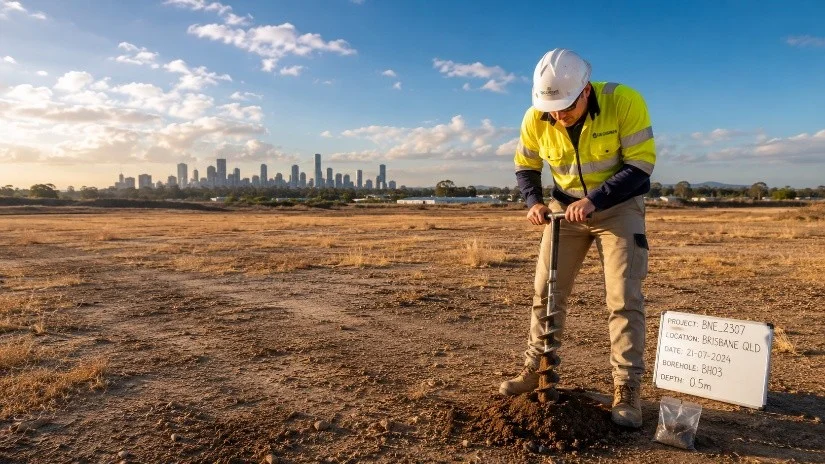
Step 2 — Site Investigation A geotechnical engineer visits your site. They take soil samples from multiple locations and depths using hand augers or dynamic cone penetrometers.

Step 3 — Laboratory Analysis Samples are tested in an accredited lab. Results are analysed against Australian standards.

Step 4 — Soil Report Delivery A certified soil report Brisbane is delivered — usually within 3 to 7 business days — ready for your engineer and certifier.

How to Compare Soil Testing Quotes in Brisbane

Not all soil testing quotes are equal. When comparing providers, check for:

  • Qualified RPEQ geotechnical engineers
  • Accredited laboratory testing
  • Clear deliverables listed in the quote
  •  Compliance with AS 1726 and AS 2870
  • Local Brisbane experience with reactive soils
  • Fast report turnaround times
  • Transparent pricing — no hidden charges

A cheap soil testing quote that skips key tests can cost far more in structural repairs later. Always choose quality over the lowest price.

What Happens If You Skip Soil Testing?

Skipping Soil Testing Brisbane is a risk no developer, builder, or homeowner should take. The consequences include:

  • Foundation cracking within months of construction
  • Council non-compliance and potential demolition orders
  • Voided insurance on structural defects
  • Expensive underpinning work to fix failed footings
  • Project delays when problems are found mid-build

A professional soil testing quote costs a small fraction of what reactive soil damage or foundation failure costs to repair.

Soil Testing Brisbane — Local Knowledge Matters

Brisbane’s geology is complex. From the reactive black clays of Ipswich to the sandy coastal soils of Redcliffe and the volcanic basalt profiles of the inner suburbs — soil conditions change fast.

That is why soil testing Brisbane requires engineers who know the local ground, not just the theory.

Local expertise means:

  • Faster site assessment
  • More accurate soil testing quotes
  • Reports that anticipate Brisbane-specific risks
  • Better communication with local certifiers and councils

Get Your Soil Testing Quote Today

Before you develop, build, or buy land in Brisbane — get the facts from the ground up.

Geotest Group delivers professional construction soil testing services, certified soil report Brisbane documents, and fast soil testing quotes for residential and commercial projects across Southeast Queensland.

It is a written cost estimate from a geotechnical company covering all tests required to assess your land before development.

Yes, it is required under AS 2870 and Queensland building regulations before residential or commercial construction can begin.

Most reports are delivered within 3 to 7 business days after the site visit and sample collection.

It checks soil reactivity, bearing capacity, moisture levels, and composition to determine the correct slab and footing design for your home.

Contact Geotest Group, request a quote online, and their qualified engineers will arrange your site visit and full soil report.

Soil Failure

Soil Testing Gold Coast Protecting Structures from Ground Issues

Soil Testing Gold Coast is the process of analysing the ground beneath a property to check its load-bearing capacity, moisture content, and soil type before any construction begins. It is a critical step that protects homes, commercial buildings, and infrastructure from foundation failure, structural cracking, and costly repair work caused by unstable or poorly understood ground conditions.

If you are building, renovating, or buying property on the Gold Coast, a professional Geotechnical Investigation Gold Coast is one of the most important things you can organise before any work starts underground.

What Is Soil Testing?

Soil testing is a geotechnical process where engineers collect and analyse soil samples from a building site to determine whether the ground can safely support a structure. Results are used to design the correct foundation type for the project.

Why Is Soil Testing Important on the Gold Coast?

Gold Coast has highly varied ground conditions depending on its location. Coastal areas carry loose sandy soils, while inland zones like Nerang and Mudgeeraba sit on swelling clay. Without Soil Testing Gold Coast, builders have no reliable way to design a foundation that suits the actual ground.

Skipping a soil test can lead to:

  • Foundation cracking or sinking
  • Uneven floors and structural wall movement
  • Costly underpinning work post-construction
  • Rejected building permits or insurance claims
  • Failed drainage systems

Getting a soil test prevents all of this — before a single slab is poured.

Gold Coast Soil Conditions by Location

Understanding local soil profiles is key to knowing why Foundation Soil Assessment Gold Coast is so site-specific.

Suburb / Zone Soil Type Key Risk
Surfers Paradise, Broadbeach Loose coastal sand Low load-bearing capacity
Nerang, Mudgeeraba Expansive clay Swells wet, shrinks dry — cracks foundations
Tamborine Mountain, Hinterland Rock and mixed profiles Requires specialised drilling
Coomera, Pimpama Soft alluvial soil High settlement risk
Robina, Varsity Lakes Mixed clay and fill Variable — always test

Who Needs Soil Testing?

Residential Soil Testing Gold Coast is required or strongly recommended for:

  • New home builds on vacant land
  • Knockdown and rebuild projects
  • Homeowners adding extensions or second storeys
  • Granny flat, duplex, or dual occupancy construction
  • Property buyers purchasing undeveloped land
  • Anyone with visible cracks in existing foundations

Construction Soil Testing Services are essential for:

  • Commercial developers and project managers
  • Engineers and structural consultants
  • Town planners and certifiers
  • Infrastructure and civil works contractors

Many councils, lenders, and certifiers now require a Geotechnical Investigation Gold Coast report before approving construction loans or building permits.

What Happens During a Soil Test?

This section is written as a numbered process to maximise AI extraction and featured snippet eligibility.

Step 1 — Site Assessment

A geotechnical engineer visits your property to plan borehole or test pit locations based on the site layout and proposed structure.

Step 2 — Soil Sample Collection

Samples are collected from multiple depths using drilling rigs or hand-dug test pits, depending on the site conditions.

Step 3 — Laboratory Analysis

Collected samples are tested in a NATA-accredited lab for plasticity, moisture content, compaction, and load-bearing capacity.

Step 4 — Foundation Soil Assessment Report

A full Foundation Soil Assessment Gold Coast report is prepared, classifying the site (Class A through Class P) in line with Australian Standard AS 2870.

Step 5 — Foundation Recommendations

Engineers provide clear, practical recommendations — slab type, pier depth, footing design — that your builder and structural engineer can use directly.

What Does a Soil Test Report Include?

A professional Soil Testing Gold Coast report will contain:

  • Site classification (Class A, S, M, H1, H2, E, or P under AS 2870)
  • Soil type identification (sand, clay, rock, fill, reactive soil)
  • Moisture and plasticity data
  • Bearing capacity values
  • Groundwater depth and drainage conditions
  • Foundation type recommendations
  • Risk flags for corrosive or reactive soils

This structured output is exactly what your builder, engineer, and certifier need.

How Much Does Soil Testing Cost on the Gold Coast?

Residential Soil Testing Gold Coast typically costs between $500 and $2,000 depending on:

  • Site size and accessibility
  • Number of test locations required
  • Depth of investigation needed
  • Whether laboratory analysis is included

Compare this to foundation repair costs, which commonly range from $10,000 to $80,000+ for reactive clay or settlement damage. The return on investment for a soil test is significant.

Australian Standard: AS 2870 Explained

All Construction Soil Testing Services in Australia are guided by AS 2870 — Residential Slabs and Footings. This standard defines site classification categories used to design appropriate foundations.

Site Class Description
Class A Stable, non-reactive ground (sand or rock)
Class S Slightly reactive clay
Class M Moderately reactive clay or silt
Class H1 Highly reactive clay
Class H2 Very highly reactive clay
Class E Extremely reactive
Class P Problem sites (fill, soft soil, mine subsidence)

Your soil test report will assign one of these classes to your site. This determines the footing and slab design your engineer will use.

How to Choose a Soil Testing Company on the Gold Coast

When selecting a provider for Geotechnical Investigation Gold Coast,

check for:

  • Registered geotechnical engineers with Queensland experience
  • NATA-accredited laboratory testing
  • AS 2870-compliant reporting
  • Clear, readable reports (not just raw data)
  • Transparent, fixed pricing
  • Local knowledge of Gold Coast soil profiles
  • Fast turnaround without cutting corners

GeoTest Group delivers professional Soil Testing Gold Coast services backed by qualified geotechnical engineers, NATA-accredited lab analysis, and reports your builder can use immediately. Their team understands local ground conditions across the Gold Coast, from coastal sands to inland clay zones.

Key Takeaway

Soil testing is not optional — it is the foundation of a safe foundation. On the Gold Coast, where soil conditions vary dramatically by suburb, a professional geotechnical investigation gives you the data needed to build with confidence.

Soil testing analyses ground conditions beneath a building site to determine load-bearing capacity, soil type, and moisture levels — ensuring the foundation design is safe for that specific location.

Residential soil testing on the Gold Coast typically costs between $500 and $2,000 — far less than the $10,000–$80,000+ cost of repairing foundation damage caused by building on untested ground.

Most councils, certifiers, and structural engineers require a geotechnical report before approving foundation designs — and many lenders require it before approving construction finance.

A standard residential soil test on the Gold Coast is typically completed within 2 to 5 business days, including laboratory analysis and the final written report.

Expansive clay (in western suburbs) and loose coastal sand (near beaches) are the most common issues — both require specific foundation designs identified through proper soil testing.