
Soil Failure

Why Do Builders Recommend Soil Testing Brisbane Before Every Project?

Before construction begins, builders need to know what is happening beneath the surface. A site may look stable and suitable for construction, but the soil underneath can vary significantly in strength, moisture, composition and drainage characteristics. This is why Soil Testing Brisbane is an important part of planning residential, commercial and civil construction projects.

A professional soil investigation provides builders, engineers and property owners with useful information about ground conditions before foundations, slabs, retaining walls or other structures are designed. Identifying potential soil problems early can help reduce construction delays, unexpected costs and structural risks.

In Brisbane, changing ground conditions, reactive clay, sandy soils, fill material, drainage issues and varying site conditions can all influence construction decisions. Rather than relying on assumptions, builders can use reliable soil test results to make better-informed decisions from the beginning.

Why Is Soil Testing Important Before Construction?

Every building transfers its weight into the ground. If the ground cannot adequately support that load, problems can develop after construction. Cracking, uneven settlement, movement and drainage issues may become expensive to repair.

Soil testing helps determine how the ground is likely to behave under the proposed construction. Depending on the project, testing may examine soil classification, moisture conditions, bearing characteristics, compaction and other relevant properties.

The results can then assist engineers and builders when determining appropriate foundation and site preparation requirements. For Brisbane projects, professional soil testing services Brisbane services can therefore form an important part of the pre-construction process.

1. It Helps Identify Reactive Soil

One of the major reasons builders recommend soil testing is to identify soil that may expand and contract when its moisture content changes.

Reactive soils can swell when they absorb water and shrink during dry conditions. Repeated movement may place stress on foundations and slabs if the structure is not appropriately designed.

A soil investigation can help identify the characteristics of the site so that engineers can consider suitable foundation solutions.

This is particularly important for homeowners planning extensions, new houses, garages, sheds and other structures where ground movement could affect long-term performance.

2. It Provides Information for Foundation Design

A foundation should be selected according to the conditions of the site rather than simply copying the foundation used on another property.

Soil testing can provide information that engineers use when assessing foundation requirements. The information may help determine whether a particular site requires specific footing considerations, additional ground preparation or other engineering measures.

Instead of guessing what is beneath the proposed building, construction professionals can make decisions based on site-specific information.

3. It Can Reveal Uncontrolled Fill

Not every property consists of natural soil. Previous construction, landscaping, demolition or earthworks may have introduced fill material onto the site. If fill has not been properly placed and compacted, it can behave differently from natural ground.

Soil testing can help identify conditions that may require additional investigation or engineering consideration.

This is one reason soil testing should not be viewed as an unnecessary expense. Discovering unsuitable ground before construction is usually much easier than discovering a problem after a building has been completed.

4. It Helps Assess Bearing Conditions

The ground beneath a structure must be capable of supporting the loads transferred through the foundations.

Soil investigation can provide information about the site’s bearing characteristics and ground conditions. Engineers can use relevant test results when developing foundation recommendations and structural designs.

When builders have dependable information about the ground, they can coordinate construction more effectively with engineers and other professionals.

5. It Can Reduce Unexpected Construction Costs

Skipping an investigation does not necessarily eliminate costs. It can simply move potential costs further into the project.

For example, if unsuitable soil is discovered after excavation has already started, the project may require additional excavation, replacement material, drainage work, redesign or other corrective measures.

Early investigation gives the project team an opportunity to identify potential issues before construction progresses too far. That can make budgeting and project planning more predictable.

6. It Helps with Site Classification

Soil and site classification can be important when planning residential construction.

A soil report can provide information about the ground conditions relevant to the proposed development. Depending on the project and applicable requirements, the findings may assist engineers and builders in determining appropriate construction approaches.

A professional construction soil testing provider can investigate the site and prepare documentation that can support the next stages of project planning.

7. It Supports Better Drainage Decisions

Water and soil are closely connected. Poor drainage can increase soil moisture and contribute to changes in ground conditions. On some sites, groundwater, surface water or inadequate drainage may need to be considered during design and construction.

Understanding the soil profile can help professionals assess how water may interact with the ground.

This can be particularly useful for sites where drainage, slopes, retaining structures or significant earthworks are involved.

What Does Soil Testing Usually Investigate?

The exact testing program depends on the project, site conditions and engineering requirements. A professional investigation may consider several characteristics of the soil.

Soil Testing Factor Why It Matters
Soil classification Helps identify the general characteristics and behaviour of the soil
Soil reactivity Helps assess potential expansion and contraction
Bearing characteristics Supports assessment of foundation requirements
Moisture conditions Helps understand how water may influence soil behaviour
Fill material Helps identify areas that may require further assessment
Compaction Indicates whether placed material has been adequately compacted where relevant
Ground profile Provides information about different soil layers beneath the site
Drainage conditions Helps identify water-related considerations

The testing required should always be determined according to the individual site and project.

When Should Builders Arrange Soil Testing?

Ideally, soil testing should be completed during the planning stage, before final construction decisions are made.

Arranging testing early gives builders and engineers time to review the findings and make appropriate design or site-preparation decisions.

It can be especially useful before:

  • New home construction
  • House extensions
  • Garages and sheds
  • Commercial buildings
  • Retaining walls
  • Subdivisions
  • Civil construction
  • Sites involving significant earthworks
  • Projects where previous fill is suspected

The earlier potential ground conditions are understood, the easier it is to incorporate them into the project plan.

What Happens During a Soil Investigation?

A typical investigation begins with understanding the proposed project and site.

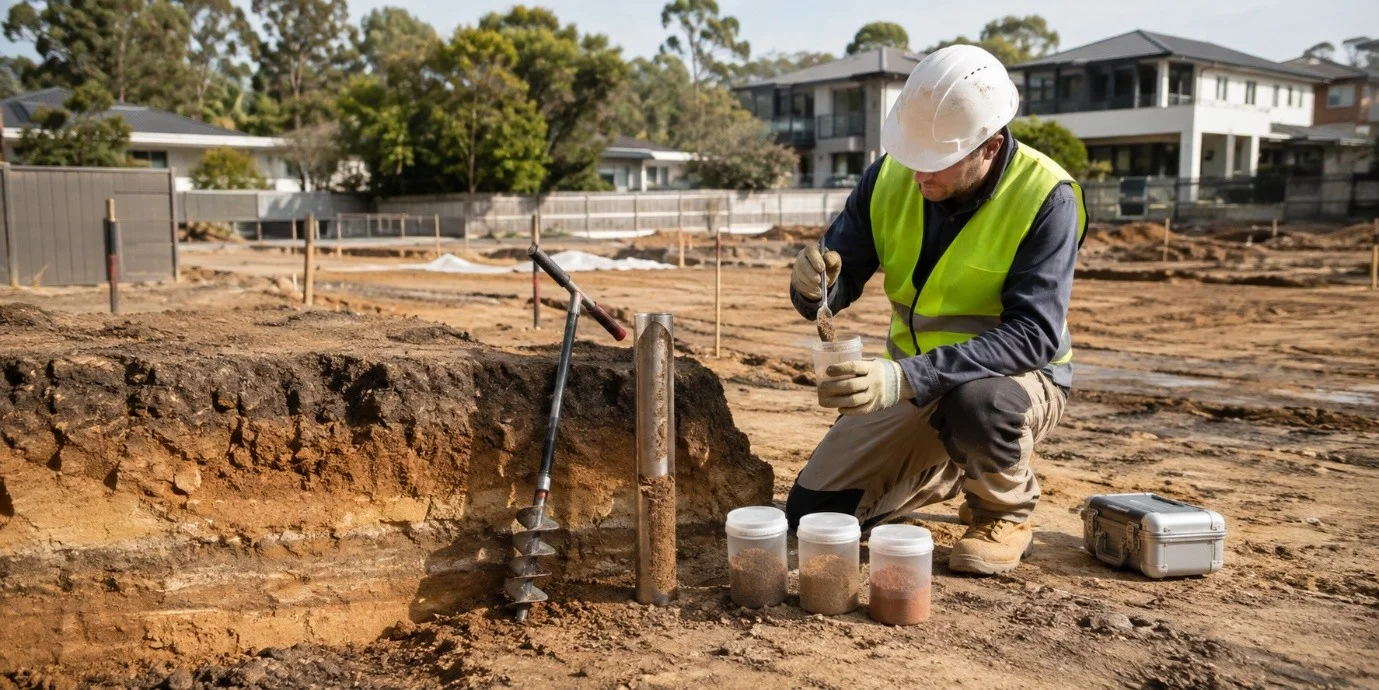
A qualified professional may visit the property and collect soil samples or perform appropriate field testing. The investigation can examine soil layers and relevant characteristics at selected locations.

Depending on the project requirements, samples may then undergo laboratory testing.

The findings are compiled into a report that can provide useful information for engineers, builders and property owners. The goal is not simply to collect soil. The goal is to understand how the ground may affect the proposed construction.

Why Local Knowledge Matters in Brisbane

Brisbane construction sites are not all the same. Ground conditions can vary between suburbs, individual properties and even different areas of the same site.

Previous earthworks, natural geology, drainage, slope and land history can all influence soil conditions.

This is why a professional site-specific investigation is more useful than assuming that nearby properties have identical ground conditions. When builders arrange foundation soil testing, they can obtain information specifically related to the site being developed.

Pro Tip: Test Before You Finalise Major Construction Decisions

Pro Tip: Don’t wait until excavation or foundation construction has started to investigate the soil. Arrange soil testing early enough for the results to influence engineering and construction decisions.

Early testing can help identify potential issues while there is still time to adjust the design, construction approach or project budget.

It is generally easier to plan around a known soil condition than to respond to an unexpected ground problem halfway through construction.

Choosing a Soil Testing Provider

 When selecting a soil testing company, consider experience, testing capabilities, reporting quality and the ability to provide site-specific information. A professional provider should understand that every property is different and should tailor the investigation to the requirements of the project.

Clear reporting is also important. Builders and engineers need information that can be understood and applied during the design and construction process.

For Brisbane property owners and construction professionals, GeoTest Group provides soil testing services designed to help clients understand ground conditions before construction moves forward.

Construction starts at ground level, but the success of a building depends heavily on what lies beneath it. Soil conditions can influence foundation selection, site preparation, drainage, construction costs and long-term building performance.

This is why builders recommend Soil Testing Brisbane before construction projects rather than relying on assumptions about the ground. By investigating the soil early, property owners and construction professionals can identify important site characteristics and make better-informed decisions.

Builders recommend soil testing because it provides information about ground conditions that can influence foundation design, site preparation, drainage and construction planning.

Soil testing is commonly required or strongly recommended for new construction because site conditions can vary considerably. The appropriate investigation depends on the project and applicable requirements.

Soil testing can help identify soil classification, reactivity, bearing characteristics, moisture conditions, fill and other ground conditions relevant to construction.

Ideally, soil testing should be arranged during the planning stage, before foundation and construction decisions are finalised.

Testing cannot eliminate every construction risk, but it can identify important ground conditions early and provide information that helps engineers and builders plan appropriate solutions.

Soil Failure

How Much Does Soil Testing Brisbane Really Matter for Homeowners?

Building a home is a major investment, and homeowners naturally focus on the design, materials, finishes and construction budget. However, one of the most important parts of a property is often hidden beneath the surface—the soil. Soil Testing Brisbane provides valuable information about the ground conditions that can influence foundation design, construction planning and long-term building performance.

Soil can vary significantly between properties, even within the same suburb or street. Factors such as soil type, reactivity, moisture, bearing capacity, previous filling and ground conditions can affect how a building should be supported. Professional testing helps engineers and builders make decisions based on actual site conditions rather than assumptions.

Why Does Soil Testing Matter for Brisbane Homeowners?

 Soil testing is more than another construction expense. It is an important planning step that helps identify potential ground-related risks before construction begins.

The foundation transfers the weight of a home into the ground. If the soil behaves differently from what was expected, movement, settlement or other issues may occur. Residential footing and slab design is linked to site classification under AS 2870, making an understanding of ground conditions particularly important.

A professional Soil Testing Brisbane assessment can help determine:

  • The type and condition of soil beneath the property
  • Whether the soil is reactive
  • Potential ground movement
  • Soil bearing characteristics
  • Whether additional investigation may be required
  • Conditions that could influence foundation design

Brisbane properties should not automatically be assumed to have identical soil conditions. Reactive clay, fill, soft ground, slopes and changing moisture conditions can all influence site behaviour.

Soil Classification and Foundation Design

 One of the key outcomes of residential soil testing is site classification. Under AS 2870, residential sites can be classified according to expected ground movement associated with soil reactivity.

Site Class General Soil Behaviour Typical Ground Movement
A Stable sand or rock Little or none
S Slightly reactive Less than 20 mm
M Moderately reactive 20–40 mm
H1 Highly reactive 40–60 mm
H2 Highly reactive 60–75 mm
E Extremely reactive More than 75 mm
P Problem site Site-specific

These classifications are a general guide. A professional investigation and engineering assessment are required to determine the appropriate conditions for an individual property.

What Happens If You Skip Soil Testing?

 Assuming that your property has the same soil conditions as a neighbouring block can be risky. Two nearby properties can have different soil profiles because of natural variation, previous excavation, filling, drainage changes and other site conditions.

Skipping appropriate testing may contribute to:

  • Foundation movement: Reactive soil can shrink and swell as moisture conditions change.
  • Cracking: Uneven ground movement can contribute to cracking in slabs or walls.
  • Unexpected costs: Challenging ground conditions may require additional engineering or foundation solutions.
  • Construction delays: Late discovery of ground conditions can lead to additional testing or redesign.
  • Poor planning: Foundation decisions should be based on actual site conditions and appropriate engineering requirements.

This is why Brisbane soil testing should be considered early in the construction process rather than after major decisions have already been made.

What Does Residential Soil Testing Involve?

The exact scope depends on the property and proposed construction. A residential investigation may include site inspection, soil sampling, field testing, laboratory analysis and site classification.

Geotest Group states that Brisbane investigations can use hand augers to assess soil type, expansivity and bearing capacity, with samples collected for laboratory analysis. A site classification report may also include subsurface conditions, borehole interpretation, soil classification, earthwork considerations, groundwater observations and a borehole location plan.

The resulting information can help structural engineers, designers and builders make better-informed decisions about the project.

When Should Homeowners Arrange Soil Testing?

Ideally, soil testing should be completed early—before foundation and structural decisions are finalised. Early information allows the project team to account for site conditions from the beginning.

Soil testing may be relevant when:

  • Building a new home
  • Purchasing vacant land
  • Planning a major extension
  • Building a pool or substantial structure
  • Developing a sloping property
  • Carrying out significant earthworks
  • Investigating suspected ground movement

 How Much Does Soil Testing Brisbane Cost?

The cost depends on the property, accessibility, number and depth of investigation points, testing requirements and site complexity.

Geotest Group indicates that small residential projects, extensions, sheds or pools on flat Brisbane sites may commonly require two boreholes, with an estimated cost of approximately $650–$950. Actual costs can vary depending on individual site conditions and testing requirements.

 Soil Testing Can Support Better Budget Planning

 Soil testing can also help homeowners make more informed financial decisions.

A block that appears cheaper may have challenging ground conditions requiring additional engineering or foundation work. Identifying potential ground-related issues early can give homeowners and their project teams a clearer understanding of possible construction requirements.

Testing cannot predict every construction expense, but it provides important site information before major funds are committed.

Choosing a Soil Testing Professional

 When comparing soil testing providers, homeowners should consider experience, qualifications, reporting, testing scope and transparent pricing.

A straightforward residential site may require a relatively simple assessment, while sloping, filled or complex sites may require more detailed investigation.

Geotest Group states that it has more than 10 years of experience and has completed more than 2,000 projects across Southeast Queensland.

So, how much does Foundation soil testing really matter for homeowners? It matters because the ground beneath your property plays an important role in foundation design, construction planning and long-term building performance.

Professional testing provides site-specific information that can help homeowners, engineers and builders make better-informed decisions before construction begins. Rather than relying on assumptions or neighbouring properties, testing allows the actual conditions of the site to be considered.

For homeowners planning a new home, extension, pool or other significant project, Residential soil testing Brisbane can be an important investment in informed planning and a more predictable construction process.

Soil Testing Brisbane helps identify soil conditions, bearing characteristics, reactivity and other ground conditions that may influence foundation design.

Testing may assess soil type, strength, expansivity, bearing conditions and other relevant subsurface characteristics. Field and laboratory testing may also be included depending on the project.

A site classification report identifies the relevant site classification and provides information that helps engineers determine appropriate foundation design requirements.

Costs vary according to the property and scope of investigation. Geotest Group indicates that some small residential projects on flat sites may commonly cost around $650–$950, although individual quotes can differ.

It is best to arrange testing during the early planning stage, before foundation and structural decisions are finalised.

Soil Failure

The Ultimate Soil Testing Brisbane Checklist for Home Builders

Building a new home is exciting, but one step decides how safe and strong your house will be for years to come. That step is Soil Testing Brisbane. Skipping it, or doing it wrong, can lead to cracked walls, uneven floors, and expensive repairs later.

This guide gives you a simple, easy-to-follow checklist so home builders in Brisbane know exactly what to check before laying the foundation.

Why Soil Testing Matters Before You Build

Brisbane has a mix of reactive clay soils, sandy patches, and rocky ground. Every suburb is different. Without proper testing, builders are basically guessing how the ground will behave.

A good Residential Soil Testing Brisbane report tells you:

  • How much the soil expands and shrinks with moisture
  • The soil classification (like Class A, M, H1, H2, E, or P)
  • Load-bearing capacity of the ground
  • Drainage behaviour and water table depth

This information decides your slab design, footing depth, and even your construction budget.

The Ultimate Soil Testing Checklist for Home Builders

Here is a simple Soil Testing Checklist for Home Builders you can follow before starting any residential project.

1. Book the Test Early

Don’t wait until the design stage is finished. Schedule your Pre-Construction Soil Testing Brisbane as soon as you finalise the land purchase. This helps architects design footings that match the actual soil, not assumptions.

2. Choose a Licensed Geotechnical Engineer

Always hire a qualified and experienced testing company. A licensed engineer follows Australian Standards (AS 2870) and gives you a report that councils and builders accept without delay.

3. Confirm the Number of Bore Holes

For most residential blocks, 2 to 4 bore holes are tested at different points on the land. Larger or sloped blocks may need more. Ask your provider how many test points are included in the price.

4. Check the Soil Classification Report

Your report should clearly mention the soil class. This single detail affects:

  • Slab type (waffle pod, raft, or strip footing)
  • Reinforcement steel requirements
  • Overall foundation cost

5. Review Site Drainage and Moisture Levels

Poor drainage is one of the biggest reasons for slab movement. Make sure the test includes moisture content and natural drainage patterns of the site.

6. Ask About Reactive Clay Levels

Brisbane is known for reactive clay in many suburbs. If your Soil Test for New Home Construction Brisbane shows high reactivity, your builder will need deeper footings or extra reinforcement.

7. Get the Report Before Finalising House Design

Never finalise your house plan before receiving the soil report. Changing footing design after construction drawings are done costs more time and money.

8. Check Turnaround Time

Most soil tests take 3 to 7 working days depending on site access and weather. Confirm this timeline so it doesn’t delay your building approval.

9. Keep a Copy for Council Approval

Your local council and certifier will need this report for building approval. Keep both digital and printed copies handy throughout the project.

10. Re-Test if Site Conditions Change

If there’s heavy rain, excavation, or a long gap between testing and construction, consider a quick re-check. Soil conditions can shift, especially in clay-heavy zones.

Benefits of Following This Checklist

  • Avoids future cracks and structural damage
  • Saves money on unnecessary over-engineering
  • Speeds up council and certifier approval
  • Gives peace of mind before construction begins
  • Helps builders quote accurately from day one

Soil Testing Brisbane is not just a formality, it’s the foundation of your entire home, quite literally. Following this checklist helps home builders avoid delays, disputes, and costly repairs down the line. Whether you’re building your first home or managing multiple projects, proper Pre-Construction Soil Testing Brisbane protects your investment from the ground up.

For accurate, council-approved soil testing services.

Usually 3 to 7 working days, depending on site access and weather conditions.

Yes, most councils require a soil report before approving building plans.

Cost depends on block size and bore holes, but it’s a small expense compared to foundation repairs later.

Many areas have reactive clay, often classified as Class M or H, requiring stronger footings.

No, soil conditions change over time, so a fresh report is recommended before construction starts.

Uncategorized

Affordable Soil Testing Companies Near Brisbane

If you’re planning to build anywhere around Brisbane, one thing is guaranteed — the ground beneath your site matters more than most people realise. That’s why many homeowners and builders look into Soil Testing Brisbane services and choose Affordable soil testing companies near Brisbane before any real work begins.

Soil testing isn’t just a box to tick for council approval. It’s how you find out whether the land you’re building on is stable, reactive, or likely to cause issues later. Brisbane has a mix of soil types, and even two neighbouring blocks can behave very differently once construction starts.

Getting the soil checked early usually saves time, money, and stress down the track.

Why soil testing is not something to skip

A lot of structural problems don’t show up straight away. Cracks, slab movement, and uneven floors often take months or years to appear. By the time they do, fixing them costs far more than the original testing would have.

That’s why experienced builders rely on Affordable soil testing companies near Brisbane to understand what’s happening below the surface before designing foundations. Soil testing gives engineers the information they need to design footings that suit the site, instead of guessing.

It’s not about overbuilding. It’s about building correctly the first time.

Residential soil testing in Brisbane

For anyone building a house, duplex, or extension, Residential soil testing Brisbane is usually the first technical step. Councils and engineers require a soil report before plans can move forward.

Many residential areas in Brisbane sit on clay-based soils. These soils expand when wet and shrink when dry, which can put stress on slabs if they’re not designed properly. Residential soil testing identifies how reactive the soil is and what foundation type will work best.

A typical residential test includes:

  • Drilling small boreholes on site
  • Collecting soil samples
  • Checking moisture and soil behaviour
  • Assigning a site classification

Using Affordable soil testing companies near Brisbane helps homeowners meet all requirements without paying for unnecessary testing.

Commercial soil testing for larger projects

Commercial soil testing Brisbane is slightly different. Commercial buildings carry more weight and usually cover larger areas, so the testing needs to be more detailed.

Warehouses, offices, and industrial buildings all depend on accurate soil data. Even small errors can turn into expensive problems once construction is underway. Commercial soil testing looks closely at bearing capacity, groundwater conditions, and long-term settlement risks.

Experienced and Affordable soil testing companies near Brisbane adjust the testing scope to suit the project, instead of applying a one-size-fits-all approach.

What soil classification testing actually means

You’ll often hear engineers talk about site classes, but Soil classification testing Brisbane is simply a way to describe how the soil behaves over time. It tells designers how much movement to expect as moisture levels change.

Brisbane soils are rarely uniform. One end of a block might be stable, while the other reacts more strongly to moisture. Classification testing captures those differences and helps avoid uneven foundation performance later on.

Correct classification reduces cracking risk and avoids unnecessary overdesign, which keeps construction costs under control.

AS 2870 soil testing explained in plain terms

AS 2870 soil testing Brisbane follows the Australian Standard for residential slabs and footings. Most councils require this standard to be met before approving construction.

The testing determines whether the soil is:

  • Stable
  • Slightly reactive
  • Moderately reactive
  • Highly reactive

Once the soil class is known, engineers can design foundations that suit the site conditions. Reputable and Affordable soil testing companies near Brisbane provide AS 2870-compliant reports that builders and councils accept without issues.

Why pre-construction soil testing matters

Pre-construction soil testing Brisbane happens before excavation or foundation work begins. This is the best time to identify anything that could affect the build, such as poor drainage zones or soft soil layers.

Testing early allows:

  • Accurate footing design
  • Better construction planning
  • Fewer surprises once work starts

Builders who work with Affordable soil testing companies near Brisbane usually avoid costly mid-project changes simply because they had the right information from the start.

How to choose the right soil testing company

Price matters, but it shouldn’t be the only factor. The best soil testing providers combine local knowledge with clear reporting.

When comparing Affordable soil testing companies near Brisbane, look for teams that:

  • Understand Brisbane soil conditions
  • Follow Australian Standards
  • Provide clear, readable reports
  • Offer upfront pricing

A good report should help builders make decisions, not slow them down.

Soil testing costs in Brisbane

Costs vary depending on access, site size, and the type of testing required. Residential testing is generally straightforward, while commercial sites need more investigation.

Working with Affordable soil testing companies near Brisbane ensures you get accurate results without overpaying. In most cases, the cost of soil testing is small compared to the long-term value it provides.

Final thoughts

Strong buildings start with good information. Choosing Affordable soil testing companies near Brisbane gives you confidence that foundations are designed for real site conditions, not assumptions.

From Residential soil testing Brisbane to AS 2870 soil testing Brisbane, professional soil testing helps projects move forward smoothly and stand the test of time.

Yes, most councils require soil testing before approving construction plans.

Most residential soil testing reports are completed within a few working days.

It determines soil reactivity and guides slab and footing design.

It should be completed before excavation or foundation work begins.

Yes, experienced Affordable soil testing companies near Brisbane deliver accurate results at fair prices.