
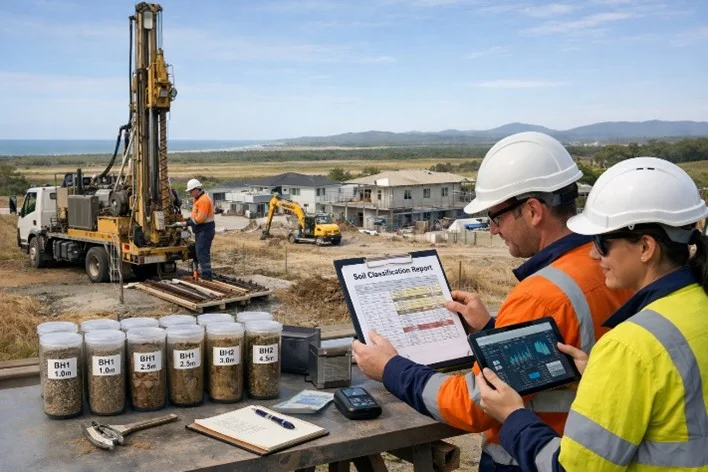
If you’ve ever stood on the headland at Burleigh or taken the winding drive up toward Springbrook, you know the Gold Coast isn’t just one long beach. It’s a wild mix of ancient volcanic remnants, shifting dunes, and river-fed plains. For a tourist, it’s a postcard. But for anyone looking to pour a concrete slab, this beautiful diversity is actually a hidden minefield. Building here isn’t just about getting your floor plan right; it’s about making sure the ground doesn’t swallow your investment whole.
That is why Soil Testing Gold Coast experts are usually the first people on a site. Long before the cranes arrive or the first brick is laid, we need to know what’s happening in the dark, damp layers beneath the grass. If you skip this, you’re basically betting your life savings on a coin toss.
Why Ground Conditions on the Coast Are So Unpredictable
The reality is that “dirt” isn’t a single thing. On the Gold Coast, we deal with a subtropical climate where it either pours for a week straight or stays bone-dry for months. This weather cycle plays havoc with the earth. When it rains, certain soils soak up water and grow like a sponge. When the sun comes back out, they shrink and crack. This “breathing” of the earth is what snaps foundations and pops tiles off walls.
Without a rigorous Gold Coast Soil Analysis, you’re flying blind. You might think you’ve got a solid patch of land, but three meters down, there could be a pocket of soft silt or a layer of reactive clay just waiting to move. Using Professional Soil Testing Services is about more than just getting a permit; it’s about making sure your home stays level for the next fifty years.
A Local’s Guide to the Types of Soil in Gold Coast Regions
To really get why a Soil Classification Report matters, you have to look at how different our suburbs actually are.
The Coastal Strip: More Than Just Sand
Down in Broadbeach, Nobbys, or Palm Beach, you’re dealing with marine sands. Now, sand is great because it doesn’t swell. However, it’s notoriously loose. If you try to build a heavy two-story house on uncompacted sand, it can settle unevenly. We also have to worry about the water table. In these low-lying areas, a Gold Coast Soil Analysis often finds water just a couple of meters down, which can lead to “liquefaction” if the ground is disturbed.
The Alluvial Flats: The Silt Trap
Move back toward the M1—places like Robina, Carrara, or the northern growth corridor in Coomera—and the geology shifts. These were once floodplains. The soil here is a cocktail of silt, clay, and loam. It’s often quite “soft,” meaning it has a low bearing capacity. If your builder doesn’t know this, the weight of the house can literally squish the soil, leading to a lopsided home.
The Hinterland: The “Reactive” Danger Zone
This is where things get tricky. In the foothills of Mudgeeraba, Tallai, and Upper Coomera, the soil is packed with reactive clays. These are the “divas” of the soil world. They expand massively when wet and turn into concrete-hard, cracked earth when dry. In these suburbs, Professional Soil Testing Services are non-negotiable. The footing requirements here are much tougher because the slab has to be strong enough to resist the earth’s constant pushing and pulling.
Decoding Your Soil Classification Report
Once the drilling rig leaves your site, the lab work begins. The result is a Soil Classification Report. This is the “ID card” for your block of land. Engineers use a letter system to tell the builder how to design your foundation:
- Class A & S: These are the “unicorns.” Stable sand or rock. Very little movement.
- Class M: This is your standard Gold Coast site—moderately reactive. It needs a good slab, but nothing too crazy.
- Class H1 & H2: “Highly” reactive. If you see this on your report, expect to see a lot more steel reinforcement and deeper concrete beams in your engineering plans.
- Class E: “Extremely” reactive. This soil is like a living thing. It moves so much that standard slabs won’t work; you’ll likely need a specialized engineering solution.
- Class P: The “P” stands for “Problematic.” This happens when there is “fill” on the site (dirt moved there by a machine), soft spots, or if the land is a known slip hazard.
The Real Cost of Skipping a Professional Gold Coast Soil Analysis
I hear it all the time: “Why do I have to pay for a soil test? Can’t the builder just guess?”
Sure, they can guess. But builders aren’t in the business of losing money. If they don’t have a Soil Classification Report, they will almost always assume the worst-case scenario. They’ll quote you for a heavy-duty “Class H” slab just to be safe. You could end up paying $15,000 extra for concrete and steel that you didn’t actually need.
On the flip side, if they underestimate the soil, the “savings” will vanish the moment your walls start cracking. Underpinning a sinking house is a nightmare that can cost upwards of $60,000. Investing in Professional Soil Testing Services at the start—which usually costs less than a decent kitchen appliance—is the smartest financial move you can make.
The “Silent” Factors: Trees and Moisture
One thing a good Soil Testing Gold Coast expert looks at is the vegetation. We live in a green city, but a giant eucalyptus tree near your building footprint is a massive red flag. Those roots suck moisture out of the clay unevenly. This creates “hot spots” of dry, shrinking soil while the rest of the block stays damp. This unevenness is exactly what causes structural failure.
Wrapping Up: Build on Facts, Not Luck
At the end of the day, the Gold Coast is a paradise, but building here requires respect for the land. Whether you’re on the sand at Main Beach or the red clay of the mountains, you need to know what you’re standing on.
A proper Gold Coast Soil Analysis takes the anxiety out of the building process. It gives your engineer the facts, your builder a clear path forward, and you the peace of mind that your home isn’t going to start cracking the moment the first summer storm hits. Don’t cut corners on the one thing that holds everything else up. Trust the experts who live and breathe Soil Testing Gold Coast to get it right the first time.
For a standard residential lot, expect to pay between $500 and $900, which includes the site visit, lab work, and the final classification report.
Usually, the drilling takes a few hours, and the laboratory analysis takes about 4 to 6 business days before the final report is emailed to you.
No, because soil profiles can change radically even within a few meters; you need a site-specific test for your exact building footprint to be insured.
It means your site has “problem” conditions like uncompacted fill or soft clay, and you will need a structural engineer to create a custom footing design rather than a standard one.
It depends on the size and the council requirements, but generally, any structure that requires a building permit will need a verified soil classification to ensure the footings are safe.


