
If your property sits on a slope or near a retaining wall, your builder or council will likely ask for a Slope Stability Report Brisbane before approving any construction. This guide answers the most common questions property owners ask — clearly and simply.
What Is a Slope Stability Report?
A Slope Stability Report Brisbane is a formal document prepared by a qualified Geotechnical Engineer Brisbane. It assesses whether the ground on or near a sloped site is safe enough to build on — now and long-term.
The report typically includes:
- A full site inspection for visible risks
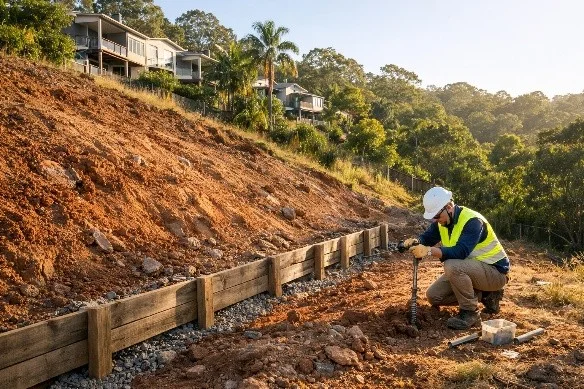
- Shallow soil testing using hand augers, Dynamic Penetrometer Tests (DPT), and shear vane tests
- Soil profile and subsoil condition analysis
- Advanced slope modelling using Finite Element geotechnical software
- Foundation design recommendations
- A site plan with soil logs and technical findings
When Do You Actually Need a Slope Stability Report in Brisbane?
Do you need one if you’re building on a sloped block?
Yes — almost always. If your block has a natural slope or sits on uneven ground, Brisbane City Council and certifiers typically require a Site Stability Assessment Brisbane before issuing a building approval. Suburbs like Paddington, Bardon, and Ferny Hills are common areas where this applies. Even a moderate slope can shift under load, especially during Queensland’s heavy wet season.
Do you need a report for a retaining wall?
Yes, especially for new builds or damaged walls. A retaining wall assessment Brisbane is essential when you’re constructing a new retaining wall or when an existing wall shows signs of cracking, leaning, or movement. The report tells structural engineers what soil pressures the wall must handle, what foundation depth is required, and what drainage must be built in to prevent failure.
Do you need one if your site is in a landslide zone?
Absolutely. Queensland’s hilly terrain and intense seasonal rainfall create real risks. A Landslide Risk Assessment Queensland is often a non-negotiable council requirement if your property is near a known landslide-prone area or steep batter. Ignoring this doesn’t remove the risk — it shifts the full liability to you as the property owner.
Do you need a report after ground movement or slope failure?
Yes — and urgently. If you’ve noticed cracking in walls, slipping soil, uneven floors, or sagging ground after heavy rain, your slope may already be failing. A forensic Site Stability Assessment Brisbane identifies the cause and guides the right remediation before the damage — or danger — escalates.
Do you need one for commercial or large-scale developments?
Yes, without exception. For subdivisions, commercial builds, or any development on a complex site, a detailed Slope Stability Report Brisbane is a standard requirement from local authorities. Structural engineers and certifiers won’t sign off on foundation design without verified geotechnical data.
What Does the Testing Process Involve?
Here’s what a qualified Geotechnical Engineer Brisbane does during a slope stability investigation:
- Site visit — Inspect slope angles, drainage, vegetation, and existing structures
- Shallow testing — 2–3 hand auger holes to 3.0–4.0 metres depth, plus DPT and shear vane tests
- Lab analysis — Soil samples tested for strength, composition, and behaviour under load
- Slope modelling — Advanced Finite Element software used to calculate stability under various load and rainfall conditions
- Final report — Includes soil logs, site plan, foundation options, and slope safety conclusions
How Much Does a Slope Stability Report Cost in Brisbane?
Most Slope Stability Report Brisbane costs fall between $1,800 and $6,000, depending on:
- The size and gradient of the block
- Number of test locations required
- Whether deep drilling (CPT or machine boreholes) is needed
- Complexity of the soil profile
For a standard hillside residential lot, costs usually sit at the lower end of this range — and it’s far cheaper than dealing with a failed foundation or council rejection mid-project.
Why Is Brisbane’s Geology a Special Challenge?
Brisbane’s ground conditions are highly variable. You’ll find reactive clay soils, basalt rock, sandstone, and loose alluvial deposits — sometimes all within the same property. Combine that with steep terrain in many suburbs and Queensland’s intense rainfall, and the need for a proper landslide risk assessment Queensland becomes very clear.
Local councils, certifiers, and engineers rely on this data to make safe, accurate decisions. Without it, your development approval stalls — and hidden ground risks stay hidden.
Who Should You Hire for a Slope Stability Report in Brisbane?
Always choose a fully licensed and experienced Geotechnical Engineer Brisbane who is registered in Queensland and has a strong track record with hillside and sloped site investigations.
Geotest Group provides professional Slope Stability Report Brisbane services including site inspections, shallow soil testing, advanced slope analysis, and fast report turnaround. Contact their Brisbane team at info@geotestgroup.com.au for a personalised quote.
When Do You Need a Slope Stability Report in Brisbane?
| Situation | Report Needed? |
| Building on a sloped residential block | Yes |
| Constructing or repairing a retaining wall | Yes |
| Site in a landslide-prone area in Queensland | Yes |
| Ground movement or slope cracking noticed | Yes |
| Commercial or large-scale development | Yes |
| Flat suburban block with no slope concerns | Check with council |
It’s required for sloped, hillside, or complex sites where councils or structural engineers need ground stability confirmation before approving construction.
Most reports are completed within a few days to two weeks, with express turnaround available for time-sensitive projects.
It covers soil pressure analysis, recommended foundation depth, drainage design, and wall specifications to ensure long-term structural safety.
Yes — forensic geotechnical investigations identify the cause of failure and recommend the correct remediation approach for your site.
Steep terrain, proximity to known hazard zones, heavy rainfall impact, or a council-flagged landslide area typically triggers a formal landslide risk assessment Queensland.


