
Building a home is huge. You’re likely obsessing over floor plans, kitchen islands, and paint swatches. But there’s a massive, invisible step that comes before all the fun stuff. It’s the dirt. Literally.
Before you pour a single drop of concrete, you have to know what’s going on underground. In Logan, the soil changes aggressively from one suburb to the next. You might be on solid rock, or you might be sitting on reactive clay that moves like a sponge. If you skip this part, you’re risking cracked walls and sinking floors.
That is why hiring Professional Soil Testing Logan experts isn’t just a box to tick—it is the best insurance policy you will ever buy.
If you have never built before, the whole “geotech” thing can sound confusing. What actually happens? Do they dig up the whole yard? Here is the no-nonsense guide to what goes down.
Why Bother with Soil Testing?
It comes down to money and safety. Logan’s geology is tricky. If your builder assumes the ground is stable but it turns out to be highly reactive clay, your foundation will fail.
The test results give you a “Site Classification.” This tells the engineer how much steel and concrete needs to go into your slab. Get it right, and your house stands firm. Get it wrong, and you are in for a world of pain.
Step 1: The Initial Chat and Quote
Everything starts with a phone call or an email. You don’t need to know the technical jargon yet. Just tell the engineering firm where your block is and what you want to build.
This is when you ask for a Soil Testing Logan. Costs can jump around a bit. If your block is flat and clear, it’s cheaper. If it’s a steep slope covered in gum trees, it might cost a bit more to get the rig in there. A good quote should be upfront—covering the travel, drilling, lab work, and the final report.
Step 2: Boots on the Ground
Once you give the green light, the technicians head out. You usually don’t even need to be there as long as they can open the gate.
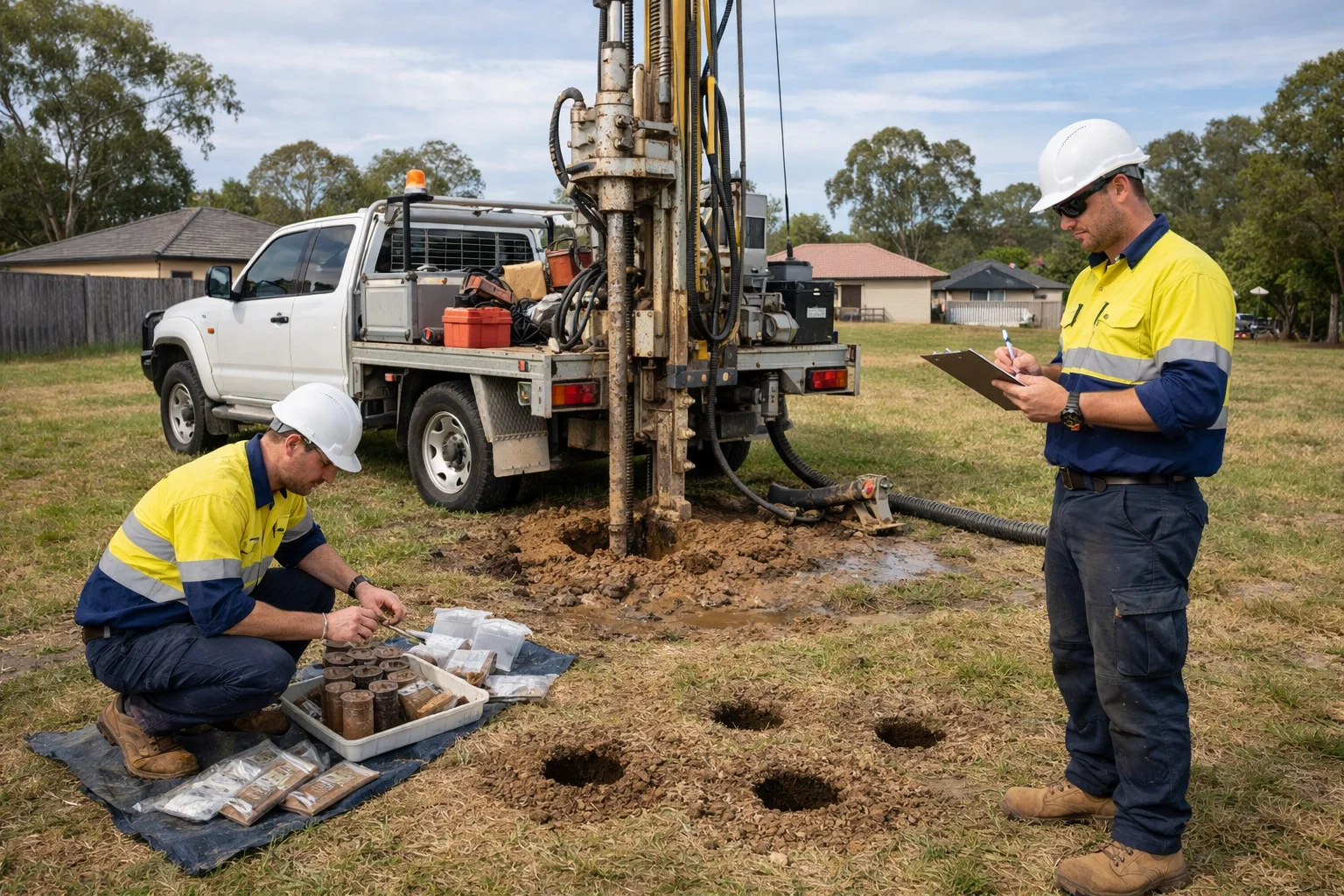
They aren’t bringing excavators to tear up the lawn. Usually, it’s a ute-mounted drill rig. They drill a couple of small holes (boreholes) to see what is happening beneath the surface.
They are looking for three main things:
- The Profile: Is it sand? Clay? Rock?
- Moisture: How wet is it down deep?
- Strength: Can this dirt actually hold up a house?
If you are building something massive or on a really dodgy slope, they might need to do a full Geotechnical Investigation Logan. That’s a deeper dive than the standard test, checking for things like landslides or groundwater issues.
Step 3: The Lab Work
Digging holes is only half the battle. The crew bags up samples and drives them back to a NATA-accredited lab.
This is where the real science happens. They torture the soil a bit—wetting it, drying it, and seeing how much it shrinks or swells. In Logan, “reactive clay” is the usual suspect. The lab calculates exactly how much the ground is likely to move over time.
Step 4: The Verdict (The Report)
A few days later, you get the Site Classification Report. This is the document your builder needs to get council approval.
You’ll see a letter grade:
- Class A / S: Solid ground. (The dream).
- Class M: Moderate movement.
- Class H1 / H2: High movement. (Very common in Logan).
- Class E: Extreme.
- Class P: Problem site.
This letter dictates your budget. A Class M slab is standard. A Class E slab needs way more reinforcement.
Local Knowledge is King

You might think dirt is dirt, but local experience counts for everything here. A technician who works in Logan every week knows the difference between the soil in Rochdale South and the soil in Greenbank.
Interestingly, many of the best firms operate across the whole region. It’s common to see crews who handle Soil Testing Gold Coast projects driving up the M1 to service Logan. This is actually a good thing. These teams see the geological shift from coastal sand to inland clay constantly. They know the transition zones better than anyone.
How Long Are We Talking?
You want to get building, so you don’t want to wait weeks for a report. The good news? Professional Soil Testing Logan is usually a quick process.
- Booking it: 1–3 days.
- Drilling: Done in a few hours.
- The Report: usually in your inbox within 5 to 10 working days.
Rain is the only real enemy here. If it’s pouring, the drill rig might get bogged, so that can cause a slight delay.
Wrapping It Up
Don’t cut corners on the dirt work. Hiring a cheap, unaccredited cowboy might save you a hundred bucks now, but it could cost you ten grand in repairs later.
Whether you need a complex Geotechnical Investigation Logan for a tricky block or just a standard check, get it done early. Grab your Soil Testing Quote Logan as soon as the land is yours, and build with confidence.
1. How much does a soil test cost in Logan?
Prices typically range from $300 to $600 for a standard residential site, though difficult access can increase the Soil Testing Quote Logan.
2. Do I need a soil test for a small extension?
Yes, most councils and engineers require a soil test to ensure the new foundation matches the existing structure’s stability.
3. Can I use a company that does Soil Testing Gold Coast for my Logan build?
Absolutely, as many reputable firms cover the entire South East Queensland region and understand the local geology well.
4. How long is a soil test report valid for?
Most engineering reports are considered valid for up to two years, provided the site conditions (like fill or excavation) haven’t changed.
5. What happens if my site is classified as "Class P"?
A Class P site means “Problem” site, requiring a Geotechnical Investigation Logan and a custom-engineered foundation design rather than a standard slab.