
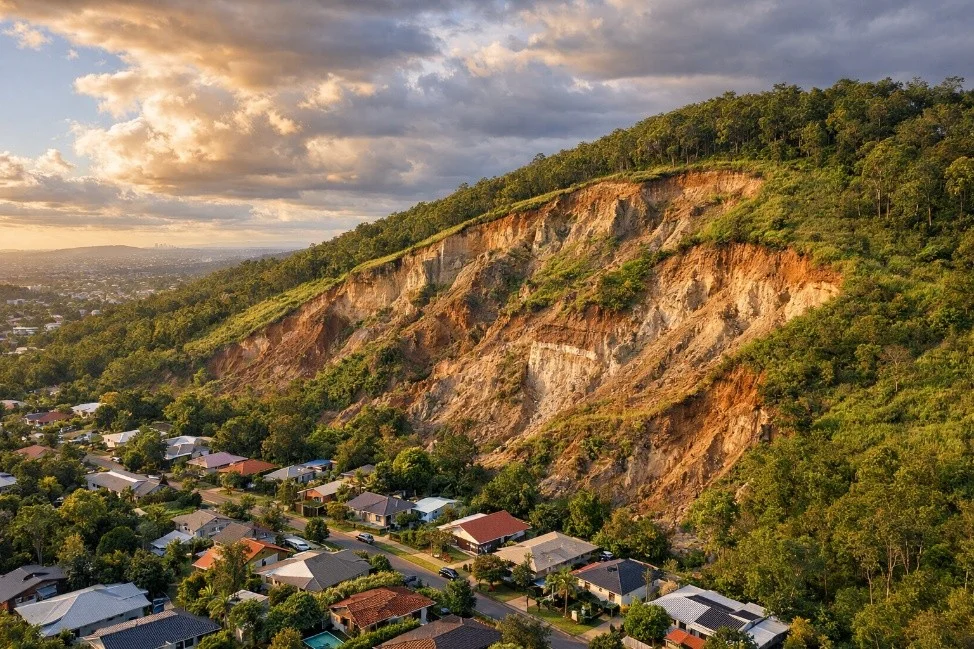
A Slope Stability Hazard Overlay Area is a council-mapped zone where land has an elevated risk of ground movement, soil failure, or landslide. Properties within these zones require a professional assessment before development can proceed.
In Brisbane and across Queensland, these overlays are built into local planning schemes. If your property is flagged, understanding the specific risks on your land is not optional — it is a legal and safety requirement.
This guide covers the six most common risks identified in a slope stability hazard overlay area, what causes them, and what assessment you need.
What Is a Slope Stability Hazard Overlay Area?
A slope stability hazard overlay area is a designated zone on a planning scheme map where the natural terrain presents a measurable risk of slope instability.
Brisbane City Council and other Queensland local governments use these overlays to:
- Identify land susceptible to landslide or soil movement
- Require geotechnical assessment before development approval
- Protect residents, buildings, and infrastructure from ground failure
If your property falls within this zone, a Slope Stability Report Brisbane geotechnical professionals prepare is usually mandatory for any development application.
Risk 1: Landslide and Ground Movement
Landslide is the most serious risk in a slope stability hazard overlay area. It occurs when soil or rock on a slope loses strength and moves downhill rapidly.
What causes it?
- Heavy or prolonged rainfall saturating the soil
- Excavation or earthworks removing natural support
- Removal of vegetation that anchors the ground
- Steep slope angles combined with weak soil layers
Why it matters in Queensland
Southeast Queensland’s wet season delivers intense rainfall events. This significantly increases landslide risk on sloped properties. A Landslide Risk Assessment Queensland evaluates slope angle, soil composition, drainage capacity, and vegetation to determine your actual risk level.
Even slow ground movement — called soil creep — can crack walls, tilt structures, and damage foundations over years without obvious early warning signs.
Risk 2: Retaining Wall Failure
A retaining wall failure occurs when a wall can no longer hold back the soil load behind it — causing it to lean, crack, or collapse.
Common causes of retaining wall failure:
- No drainage behind the wall (water pressure builds up)
- Wall built without engineering design
- Age and deterioration of materials
- Increased load from new construction nearby
- Root damage from nearby trees
A Retaining Wall Assessment Brisbane examines the wall’s structural integrity, footing depth, drainage condition, and load-bearing capacity.
Warning signs to act on immediately:
- Visible leaning or tilting
- Horizontal cracking across the wall face
- Bulging in the mid-section
- Water seeping through the base
A failed retaining wall is a safety hazard, not just a maintenance issue. Professional assessment is essential before any slope-side construction.
Risk 3: Soil Erosion and Surface Loss
Erosion is the gradual removal of soil by water or wind. On sloped land, rainfall accelerates erosion and weakens the ground layer beneath structures.
How erosion creates instability:
- Topsoil washes away, reducing ground strength
- Stormwater channels form, concentrating water flow
- Foundation depth reduces over time
- Slope gradient effectively increases as material is lost
Erosion is frequently identified during a Site Stability Assessment Brisbane — and is one of the most preventable risks with proper drainage and ground cover management.
Unmanaged erosion can undermine building foundations within a few years on steep Queensland properties.
Risk 4: Soil Saturation and Liquefaction
Soil liquefaction occurs when saturated soil temporarily loses its shear strength and behaves like a liquid under pressure or vibration.
This risk is most relevant in:
- Silty or sandy soils common in parts of Queensland
- Low-lying areas at the base of slopes
- Sites with poor drainage or high water table
A geotechnical engineer Brisbane will conduct soil testing to identify soil type, permeability, and saturation risk. These results directly inform the engineering design for any structure built on the site.
After significant rainfall events, previously stable slopes can fail quickly if the soil reaches saturation point.
Risk 5: Foundation Instability
Foundation instability in a slope stability hazard overlay area occurs when soil movement, expansion, or contraction affects a building’s structural base.
Why Queensland soils are particularly prone:
Queensland has significant areas of reactive clay soil. This soil type:
- Expands when wet
- Contracts when dry
- Moves seasonally, applying stress to footings
Over time, this movement causes:
- Cracked concrete slabs
- Misaligned door and window frames
- Uneven floors
- Structural wall cracking
A slope stability report Brisbane will include specific footing and slab design recommendations to account for soil reactivity and slope conditions.
Risk 6: Stormwater and Drainage Failure
Inadequate stormwater management on sloped land concentrates water flow, increases erosion, oversaturates soil, and adds pressure to retaining structures.
In a slope stability hazard overlay area, drainage design is a critical engineering consideration — not an afterthought.
What a drainage review covers:
- Surface water flow paths across the site
- Capacity of existing drainage infrastructure
- Risk of water pooling near foundations or retaining walls
- Recommended drainage upgrades for safe development
Your Site Stability Assessment Brisbane must include a drainage review. Redirecting water flow away from vulnerable slope areas significantly reduces overall instability risk.
What Triggers a Formal Assessment Requirement?
| Trigger | Assessment Required |
| Development application in overlay zone | Slope stability report Brisbane |
| Retaining wall construction or repair | Retaining wall assessment Brisbane |
| Earthworks, cut, or fill operations | Site stability assessment Brisbane |
| Signs of slope movement or wall cracking | Geotechnical engineer Brisbane |
| Planning for sloped site in Queensland | Landslide risk assessment Queensland |
Who Conducts These Assessments?
A registered geotechnical engineer is the qualified professional who conducts slope stability and site stability assessments in Brisbane and Queensland.
They are responsible for:
- Soil sampling and laboratory testing
- Slope angle and stability calculations
- Drainage analysis and recommendations
- Preparing reports that meet council requirements
- Certifying that a site is safe for the proposed development
A Geotechnical Engineer Brisbane must be registered with Engineers Australia or equivalent and experienced in Queensland soil and terrain conditions.
A slope stability hazard overlay area presents six core risks: landslide, retaining wall failure, soil erosion, liquefaction, foundation instability, and drainage failure. Each risk requires a professional assessment — typically a slope stability report or site stability assessment — before Brisbane City Council will grant development approval. A qualified geotechnical engineer Brisbane prepares these reports based on soil testing, slope analysis, and drainage review.
It is a council-mapped zone where land carries a higher risk of ground movement, slope failure, or landslide, requiring geotechnical assessment before development.
Yes — any development application within a mapped hazard overlay zone in Brisbane typically requires a formal slope stability report prepared by a geotechnical engineer.
A site stability assessment in Brisbane generally takes three to seven business days, depending on site access, soil testing requirements, and report complexity.
Yes — a geotechnical engineer conducts a full retaining wall assessment covering structural integrity, drainage conditions, footing depth, and load-bearing capacity.
No — only properties within council-mapped overlay areas or those triggering specific development thresholds require a formal landslide risk assessment in Queensland.